More filtration to help nitrates?

  • We are currently upgrading MFK. thanks! -neo
Yeah that’s the one! Got it set up the same way with eheim substrat pro instead of biohome! That’s why I’ve not cleaned my filters as much as I probably should have! Also says prime can knock bacteria out! Recently just switched to this as I thought my water change schedule was enough! Thanks everyone
 
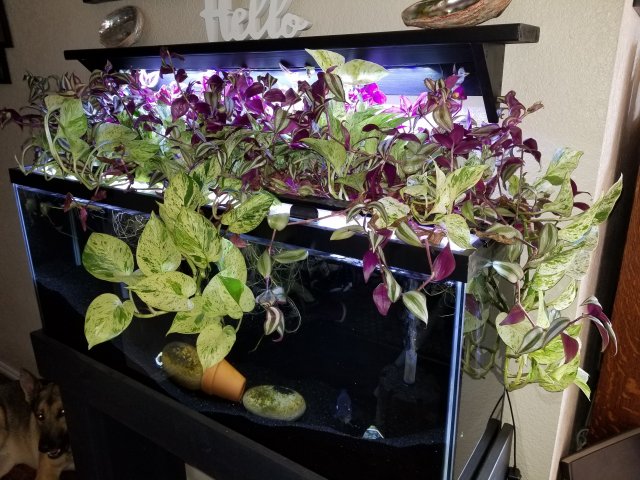
Also i have a hood on my tank so growing plants outside isn’t really an option! Plus the silver dollars ain’t helping the plants to eat nitrates out either
 
Another thing to consider is how thorough your cleanings are during water change. I tend to do a lot of drain and fill water changes for the purpose of saving time, but all my cichlid tanks that have gravel substrate and no plants need a good deep gravel vac every once and a while. Otherwise I will start noticing nitrates due to all the detritus that collects under the substrate, especially under areas where there are large rocks or driftwood that prevent the cichlids from churning up the gravel in those areas.
 
  • Like
Reactions: Shane templar
Yeah that’s the one! Got it set up the same way with eheim substrat pro instead of biohome! That’s why I’ve not cleaned my filters as much as I probably should have! Also says prime can knock bacteria out! Recently just switched to this as I thought my water change schedule was enough! Thanks everyone
I forget his explanation for why Prime is bad for the nitrate part of the cycle. I don't use Prime (well water) so I don't remember his reason. That's the thing it seems to me, low tech nitrate control is more foolproof, other methods can work but seem more finicky and potentially more expensive. I've seen him say Eheim is pretty good media, not as good as his (of course), but pretty good. I do use his basic ideas about media, etc. but don't rely on that alone. I still do big water changes, I like plants in some tanks, etc.
 
  • Like
Reactions: Shane templar
The bacteria do not multiply in response to more filter media. It isn't the filter that matters, it is the media. And that matters in terms of type and amount as to how much and what types of bacteria it can host. But, in a tank, only two things can work to handle ammonia, bacteria and archaea (microorganisms) and live plants. The bacteria prefer NH3 (ammonia) while the plants prefer NH4 (ammonium). Plants can use ammonium faster than bacteria can use ammonia. The big difference between the two is that when microorganisms oxidize ammonia there is nitrite and nitrate involved. When plants consume ammonium, there is no nitrite or nitrate involved. Moreover, some plants will use nitrate as well, especially of there is a lack of ammonium for them. This explains what caused your nitrate issues. What determines how much nitrifying bacteria is in a tank is not the filter, it is the amount of ammonia being produced.

A veggie filter would help, but you may not want to do that. A Mattenfilter would also help. But this takes months to establish the facultative anaerobes that would help with nitrate. Here is a bit of the explanation for how this works from Swiss Tropicals:
All filters break down proteins and ammonium to nitrate and do so mostly based on the amount of food added to the tank. Filters do not make NO2 or NO3 out of thin air. Depending on the surface area filters also denitrify NO3 into elementary N2 with anaerobic microorganism. It is often mentioned that happens only in deep substrate layers or live rock but that is not the complete story. Biofilms that cover any surface in the tank (and most importantly the large inner foam surface) have aerobes residing in the top layers. But in the lower layers they contain anaerobes that use the oxygen in NO3 for their metabolism. The reason why the huge surface area in both Mattenfilters and Cornerfilters works so well is that the material does not clog and thus runs undisturbed for long periods of many months or even years. Hence, the biofilm becomes more mature and then breaks down more NO3. Of course, after many months or even years or with a heavy waste load, the foam like any other media needs to be rinsed to remove excess organic material to work properly.


Nitrate spikes are often the result of heavy feeding with low-quality food that is not properly digested by the fish. That quickly increases the NO3 concentration. If the filter has to be rinsed every other week or once a month because it clogs, the biofilm cannot mature fully and little denitrification is achieved
from http://www.swisstropicals.com/faq/
 
  • Like
Reactions: fishhead0103666
Normal filtration does not reduce nitrate.
In fact gunk buildup in filters promotes nitrate.
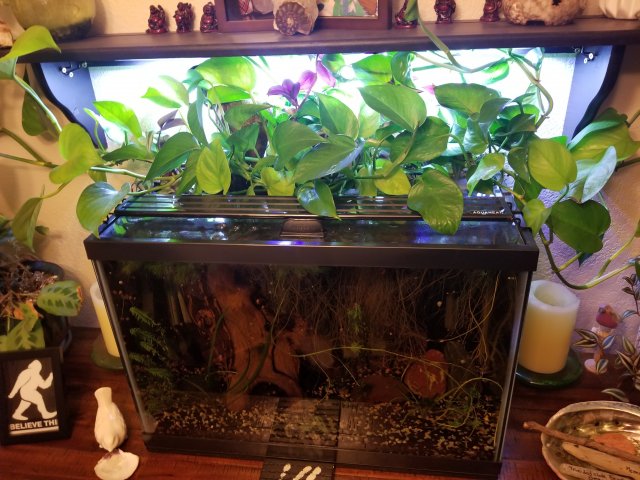
Cleaning gunk from media often, will help, water changes are the best source of reducing nitrate, and if aquatic plants are eaten by the SDs, you could try growing terrestrial plants either rooted in the tank, in a HOB baster space, or in a refugium/sump.
Beside my daily 20% water changes, and aquatic plants, I grow terrestrials in the tank, and sump.

I completely agree with Duanes!

Biological filtration breaks the very harmful Ammonia down to Nitrites then a separate species of bacteria breaks Nitrites down to much less harmful Nitrates. Although Nitrates are less harmful to your fish than nitrites and ammonia BUT they are still harmful to your fish when in high concentrations!

Does your tap water have Nitrates in it? If your tap water has nitrates then water changes aren't helping your nitrate levels... BUT I am DEFINITELY not saying you should abandon water changes!!!!

Dirty filters promote Nitrates. I specifically select filters that are easy to clean/maintain. Removing debris BEFORE it has a chance to break down to Nitrates is a good first step in controlling the Nitrate level in your tank. Besides keeping your filters clean you need to keep your whole tank clean of debris.

I am also a BIG fan of terrestrial plants like Pothos to help remove nitrates from your water. They will not eliminate nitrates from the water but when grown in a sufficient density they can have a notable positive effect on lowering the Nitrate levels in your tank.

If all else fails, especially if you have Nitrates in your tap water, it is time to look at chemical filtration to remove nitrates. Seachem Purigen is an excellent resin for removing Nitrates, Nitrites and Ammonia from your tank water. When the Purigen has been exhausted it turns brown and is no longer effective at removing these compounds. BUT Purigen can be "Recharged" by a process that involves soaking it in a very mild bleach solution. After the Purigen has been recharged you need to further neutralize the bleach before putting it back into your filter. Using Purigen can get tedious but it is quite effective when all else fails!
 
I completely agree with Duanes!


If all else fails, especially if you have Nitrates in your tap water, it is time to look at chemical filtration to remove nitrates. Seachem Purigen is an excellent resin for removing Nitrates, Nitrites and Ammonia from your tank water. When the Purigen has been exhausted it turns brown and is no longer effective at removing these compounds. BUT Purigen can be "Recharged" by a process that involves soaking it in a very mild bleach solution. After the Purigen has been recharged you need to further neutralize the bleach before putting it back into your filter. Using Purigen can get tedious but it is quite effective when all else fails!

Incorrect, purigen does not remove nitrates, ammonia or nitrates. It prevents the creation of all three by binding the organic compounds.

from Seachem
...Purigen® controls ammonia, nitrites and nitrates by removing nitrogenous organic waste that would otherwise release these harmful compounds....


There are other resins/chemical filtration that will remove either ammonia or nitrate
 
The bacteria do not multiply in response to more filter media. It isn't the filter that matters, it is the media. And that matters in terms of type and amount as to how much and what types of bacteria it can host.
I agree and have said so before, your bacteria colony will grow to according to the available nutrients. That's it, that's what they do. It's why I've never followed the you can never have too much filtration philosophy. Ime there's a sweet spot with bio-load, filtration, water changes, etc. that can vary from tank to tank. I've found there's multiple ways to get there, so I don't try to meet a particular formula for water volume turnover, media volume, etc. As long as I get the results I want I'm good, if not I tweak things a bit. Sometimes a relatively modest change makes the difference to get a tank to a healthy balance. Sometimes it's meant replacing the media that came with the filter with something better or some other simple tweak.
 
  • Like
Reactions: Backfromthedead
MonsterFishKeepers.com