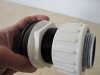
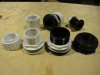
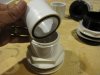
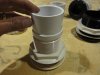
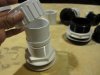
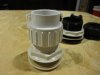
There are a lot of different bulkheads out there.
First it is important to differentiate the two different types of pipe threads, NPT (National Pipe Tapered) and NPS (National Pipe Straight). Both NPT and NPS have the same thread angle, shape, and pitch (threads per inch). However, NPT threads are tapered and NPS threads are straight (parallel). Both threads have a 60° included angle and have flat peaks and valleys.
NPT threads are meant for a male-thread to female-thread connection and seal tighter as they are torqued more. Typically you use teflon tape or pipe-dope to help seal the connection.
NPS threads are meant to be used with a gasket and tighten all the way down without resistance (like a bolt or nut thread). They do not require the use of teflon tape or pipe dope (although a light application of pipe-dope does help lubricate the threads).
It is possible to mate NPT and NPS threads in low-pressure applications with plenty of teflon tape, but it is not "up-to-code".
The most commonly available aquarium bulkheads are the black PVC schedule 40 slip x slip bulkheads. These have a a "slip" or "socket" fitting on the inside and out. The threads on the outside of the fitting are straight threads, but they are not NPS threads. These are only for the tightening nut and will not match up to NPS or NPT threads. These bulkheads are popular because they allow for the largest possible cross-section through the smallest possible hole. Other bulkheads (schedule 80 thread x thread, for example) require a considerably larger hole to be drilled for a given pipe size.
There are bulkheads with NPT threads inside and out, bulkheads with NPT on the inside and NPS outside, and bulkheads with NPT threads inside and left-hand threads outside. There are other variations including different combinations of slip fittings, barbed fittings, NPS, NPT, and other threads as well.
The moral of the story is that there are a lot of ways to make a bulkhead, each one needs to be looked at for what it is.