


Post Your Large Peaceful SA Cichlid setups
- Thread starter gobucks1
- Start date
You are using an out of date browser. It may not display this or other websites correctly.
You should upgrade or use an alternative browser.
You should upgrade or use an alternative browser.


I love that tank Japes... nice and simple and elegant. Same with your photography skills. That driftwood on the right is almost identical to the piece I have in mind for my tank that I haven't been able to find yet. Why does it seem like your 140 is smaller than that and the 75g is larger (like a 125)? Are they unusual dimensions or is it just the perspective?
I've been noticing several people lately asking how Jurupari do with certain other fish... in my experience Jurupari are by far the most peaceful cichlid. Mine have never exhibited even a hint of aggression and also seem to never be the victim of it either.
Interesting that you mention the orangehead females coloring down with Altifrons around. Have you ever blended orangehead males with altifrons too? I was considering putting a few smaller altifrons in my tank with my orangeheads (can't put huge ones in there though because I have tetras that'd become snacks) but will have to reconsider if it means the orangeheads won't look as nice.
For now I have my SAs in a 5 foot 110g with some other community fish that don't fit in any other tanks. Eventually the plan is to put them in a huge homemade in-wall tank that'll be at least 8x4 feet. I'll have an aro or three patrolling the surface and as many eartheaters as I can find roaming the bottom. I'm becoming a fan of severums and the other fish I'm seeing pictured here too, and am glad to know they mix well with eartheaters. But don't severums eat plants sometimes?
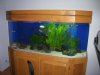
Here are a few pics of my tank taken when the plants were much better off. (I've been too lazy to set up my CO2 so the swords have all gone to waste.) Aside from the random fish, there's a jurupari and 2 pairs of Orangeheads. I've also got a 20g growout full of orangehead juvies (and temporarily, the adults) that will graduate 4-6 more orangeheads to the main tank soon.



I've been noticing several people lately asking how Jurupari do with certain other fish... in my experience Jurupari are by far the most peaceful cichlid. Mine have never exhibited even a hint of aggression and also seem to never be the victim of it either.
Interesting that you mention the orangehead females coloring down with Altifrons around. Have you ever blended orangehead males with altifrons too? I was considering putting a few smaller altifrons in my tank with my orangeheads (can't put huge ones in there though because I have tetras that'd become snacks) but will have to reconsider if it means the orangeheads won't look as nice.
For now I have my SAs in a 5 foot 110g with some other community fish that don't fit in any other tanks. Eventually the plan is to put them in a huge homemade in-wall tank that'll be at least 8x4 feet. I'll have an aro or three patrolling the surface and as many eartheaters as I can find roaming the bottom. I'm becoming a fan of severums and the other fish I'm seeing pictured here too, and am glad to know they mix well with eartheaters. But don't severums eat plants sometimes?
Here are a few pics of my tank taken when the plants were much better off. (I've been too lazy to set up my CO2 so the swords have all gone to waste.) Aside from the random fish, there's a jurupari and 2 pairs of Orangeheads. I've also got a 20g growout full of orangehead juvies (and temporarily, the adults) that will graduate 4-6 more orangeheads to the main tank soon.

gobucks1;2745966; said:peathenster;2740447; said:Looking great.
How do the Uaru and the satanoperca get along?
they get along great !!!!!!!!!!
bl00;2745977; said:That's a fine tank, Barley. Is that a car's side panel on top of your tank?
Thanks, and yes it is a front fender from a corvette

freeskier;2748883; said:is that a pepper grinder for fish food??
Sure is - it's fantastic for feeding communities. It actually came as a salt grinder though just to be safe.
DaveB;2749639; said:I love that tank Japes... nice and simple and elegant. Same with your photography skills. That driftwood on the right is almost identical to the piece I have in mind for my tank that I haven't been able to find yet. Why does it seem like your 140 is smaller than that and the 75g is larger (like a 125)? Are they unusual dimensions or is it just the perspective?
75G is 60x15x18" LWH.
140G is 48x24x28" LWH, so it's basically a 125. I can't get a full tank shot from front on because of the width of the room it's in and all I've got on for the 400D at the moment is a 50mm and 75-300mm lens which means I need to be quite far back. I don't think I'm quite happy with the stocking in this tank, and I'll eventually change it.
DaveB;2749639; said:Interesting that you mention the orangehead females coloring down with Altifrons around. Have you ever blended orangehead males with altifrons too? I was considering putting a few smaller altifrons in my tank with my orangeheads (can't put huge ones in there though because I have tetras that'd become snacks) but will have to reconsider if it means the orangeheads won't look as nice.
Well this is something myself and a few other Eartheater keepers have been discussing on a local forum. I originally thought (without venting) that I had 2M 1F with the Orange Heads - they were later vented with 2 definite females and an unsure mark on the third, but only one even began to show Orange in the forehead region over the 6+ months I kept them. They were quite decently sized around the 4-4.5" mark so they should have definitely been showing colour. From everything I've heard and read, the Rio Araguaia Orange Heads seem to be much more temperamental with their orange than the Tapajos variant when kept in communities. I fed a fantastic diet including a lot of red colour enhancers such as Beta carotene in TetraColor, with a staple of NLS Thera A+ and Cichlid Formula combined with all of the top Hikari products as well as many of their favourite live foods such as Blackworms and Earthworms for little or no change.
Interestingly, during a filter cleanout where I was forced to flush the ceramic powder from the bottom of an Eheim Classic, causing the tank to become hugely cloudy, all 3 of them showed full orange heads, with black throats and black pelvic fins - they obviously liked the dirty tank. Whether or not this eliminates the possibility that they were just low quality fish I don't know - they were purchased from a local breeder and I picked the three I had from around 15 remaining, and I had inspected the parents and was more than happy with their size, colour and body shape to warrant the purchase.
Myself and the others in this discussion pretty much concluded that as a subdominant species without a properly organized colony, you're going to see very little colour from them. In my case they were being kept with a larger, very dominant (but not physically aggressive at all) G. altifrons, and 2 larger A. heckelii, which generally keep to themselves but will intimidate smaller fish - plus my Heroines, however they never have any conflicts with my Eartheaters due to the differing body shapes and colouration.
Here's a shot from July 13, 2007 of my 'dominant' Geophagus sp. 'Araguaia Orange Head' which I believed to be male at the time - this was about the most orange I ever saw around the head from any of the fish.

Very healthy fish, well fed with great colour in the fins - but just no Orange on the head; and they're really quite bland without it in all honesty.
In your case, if you have an established colony or pairs of Orange Heads in the tank, I'd say give the altifrons a shot - you can always sell large Eartheaters without too much of an issue (over in Australia you can anyway), so if it doesn't work out there's really no harm done. If you're keeping the Tapajos variety you may be fine regardless, I've personally seen them in large communities at around the 4" mark sifting actively with no worry in the world around 10-12" altifrons, Rio Branco, abalios, etc with fantastically coloured heads.
Hopefully I have more luck with my tiny little colony growing up in the 75G. Much better chance at a better ratio of sexes and they'll be the dominant species once they outgrow my dorsigera (not that they're in any way dominant).

Here's dad, so hopefully all will be well.
Anyway that was quite a huge rant from me - hope some of that helps in some way.
Cheers.
you guys have some briliant sa setups very nice. really makes me want to set up a tank for some eartheaters.
(Hopefully this discussion is interesting to everyone else so we're not totally derailing the thread...)
Ah, so it is longer. And shorter, which makes it look much like a 125. What about the stock don't you like?
I feed the same stuff as you and one pair of my orangeheads has no orange at all. They used to, when I got them, and when they tried breeding repeatedly, but around the summer they lost their orange, stopped trying to breed, and took on a darker, bluer tint overall. The addition of the 2nd pair didn't help their color, and the 2nd pair got a bit duller as well for a while, but now the 2nd male is quite bright, although not perfect. He's the one lurking in the juvy photo I posted. I have long worried that something mysterious and non-fatal infected them in their old 55g tank. Something that causes just enough stress to leave them feeling only about 80-90%, like a minor parasite, but I have no proof of that plus have treated the tank with prazi and levamisole in the past for other things without any change. I'd say I'm just being paranoid but the two juvies that I bought from another source as the rest, which lived in the main tank with the adults til recently, are also color-free, while the 14 others their size from the other source are brilliant orange.
Attached below are pics of the original male when I first got them and more recently, orange-free. Same fish. I agree - without the orange, they're quite boring. Since they were orange before, I'm more upset by this than I would be otherwise.
Have you found your dorsigera to be especially sensitive to water conditions or anything? I had 4 of them, really like them, but have had terrible luck. I lost three between about 3 and 8 months and the last one, which I've had for maybe 9-10 months total, is looking awful, has a white zit on his head, and has been hospitalized. I've never heard of anyone having problems with them... maybe I just got a bad batch. They did come from a Petsmart, after all.
(The male: photos dated March 2, 08 and Feb 2, 09)


japes;2750632; said:75G is 60x15x18" LWH.
140G is 48x24x28" LWH,
I don't think I'm quite happy with the stocking in this tank, and I'll eventually change it.
Ah, so it is longer. And shorter, which makes it look much like a 125. What about the stock don't you like?
Interesting. I had not read that. In fact I would've guessed the opposite, at least judging from how good all the Araguaias I've seen in photos have looked. Does that reading also include any way to tell the two variants apart?From everything I've heard and read, the Rio Araguaia Orange Heads seem to be much more temperamental with their orange than the Tapajos variant when kept in communities.
I feed the same stuff as you and one pair of my orangeheads has no orange at all. They used to, when I got them, and when they tried breeding repeatedly, but around the summer they lost their orange, stopped trying to breed, and took on a darker, bluer tint overall. The addition of the 2nd pair didn't help their color, and the 2nd pair got a bit duller as well for a while, but now the 2nd male is quite bright, although not perfect. He's the one lurking in the juvy photo I posted. I have long worried that something mysterious and non-fatal infected them in their old 55g tank. Something that causes just enough stress to leave them feeling only about 80-90%, like a minor parasite, but I have no proof of that plus have treated the tank with prazi and levamisole in the past for other things without any change. I'd say I'm just being paranoid but the two juvies that I bought from another source as the rest, which lived in the main tank with the adults til recently, are also color-free, while the 14 others their size from the other source are brilliant orange.
Attached below are pics of the original male when I first got them and more recently, orange-free. Same fish. I agree - without the orange, they're quite boring. Since they were orange before, I'm more upset by this than I would be otherwise.
I have noticed this with mine too. I haven't really clouded the tank, but when doing WCs, the slightly cloudy water plus lower water level changing the way the light hits, they get slightly more orange. Part of me wonders if I should just bite the bullet and put some new driftwood in to leak tannins into the water. My monster tank had that going on for about 6 months though and I hated the tinted water.Interestingly, during a filter cleanout where I was forced to flush the ceramic powder from the bottom of an Eheim Classic, causing the tank to become hugely cloudy, all 3 of them showed full orange heads, with black throats and black pelvic fins - they obviously liked the dirty tank.
Well, if I get a few Altifrons or Abalios I'm going to get them smaller, just because I'd prefer to let the Tetras live out their lives naturally rather than getting eaten. So I would hope that wouldn't be a problem. And I am pretty sure I have the tapajos variety, although really, I have no idea how to tell. We'll see what the swap meet on sunday has as far as other eartheaters. They're usually very African-centric, so there might not be any good geos at all, or maybe I'll hit the jackpot. Who knows. If I don't end up with anything else it's not like I'll be at a loss for fish. The only thing I really need to get is a couple more jurupari since I have just one. Tough to find legit jurupari though, since they're all really leucosticta over here.In your case, if you have an established colony or pairs of Orange Heads in the tank, I'd say give the altifrons a shot - you can always sell large Eartheaters without too much of an issue (over in Australia you can anyway), so if it doesn't work out there's really no harm done.
Well, if my luck with the younger ones vs. the older ones is any indication, your little ones will do much better.Hopefully I have more luck with my tiny little colony growing up in the 75G. Much better chance at a better ratio of sexes and they'll be the dominant species once they outgrow my dorsigera (not that they're in any way dominant).
Have you found your dorsigera to be especially sensitive to water conditions or anything? I had 4 of them, really like them, but have had terrible luck. I lost three between about 3 and 8 months and the last one, which I've had for maybe 9-10 months total, is looking awful, has a white zit on his head, and has been hospitalized. I've never heard of anyone having problems with them... maybe I just got a bad batch. They did come from a Petsmart, after all.
(The male: photos dated March 2, 08 and Feb 2, 09)
DaveB;2751238; said:What about the stock don't you like?
I'd like more Eartheaters. I have a compulsive disorder with numbers too and it doesn't really fit what I'd like. If I could have 2 Heckelii again I'd be happier. The tanks too high to have only Eartheaters in there in my opinion so the Heroines will stay.
DaveB;2751238; said:Does that reading also include any way to tell the two variants apart?
From Thomas Weidner's book, 'South American Eartheaters'.
Thomas Weidner said:'There are a number of distinct characteristics by which G.sp. Araguaia Orange head can easily be distinguished. This species has a somewhat longer lateral spot, which lies below the upper lateral line but a scale width above the lower lateral line. This form is rather slimmer than its close cousin from the Tapajos. The upper head profile is more rounded and the orange area above its eyes is nothing like as bold.
Myself and another keeper that I speak to also agree that most Araguaia have higher profiled bodies than Tapajos.
DaveB;2751238; said:Have you found your dorsigera to be especially sensitive to water conditions or anything?
I've only had them for a week funnily enough, and they've been in a tank undergoing a minicycle due to a huge cleanout with slight Ammonia readings (0.25ppm @ pH 7) and they've been fine. I've been keeping a really close eye on them because I'm paranoid when water isn't perfect, and they've shown absolutely no ill effects for the 3-4 days that it took to cycle through properly.
