

Reptiles as social creatures
- Thread starter varanio
- Start date
You are using an out of date browser. It may not display this or other websites correctly.
You should upgrade or use an alternative browser.
You should upgrade or use an alternative browser.
andyjs;2423992; said:What about gators caring for their young? What are your opinions on that behavior?
Instinctual behavior, thats common amongsnt some species. Pythons guarding eggs etc.... but is that considered social; semi social....or maternal instinct. Its not like momma gator is feeding her hacthlings, they still have to fend for themselves during this short period where mom acts as a bodyguard.
What Ive learn also is that the social behavior of herps is as diverse as the animals themselfes. They may be very social(painted terrapins wich swim in groups in the rivers of Borneo), indiferent to the presence or absence of menbers of their own kind except for mating(most fall in this category) or higly territorial, defending and mantaining a territory wich may be used or not by menbers of the oposite sex(iguanas, agamids, some geckos,etc). A few other combinacions apear as well. Most herps are completly poligamic  However a few are monogamic and the bond that unites the menbers of the copple may be stronger than what happens between some people
 Examples are the dwarf blue tonges and the single back skinks. Also regarding parental care some are very protective even to the point that the youngsters stay with the parent a long time( the past 2 skinks and the monkey tail skink, as well some iguanas), some are inicialy very proctetive but then see the juveniles as main corse(many crocodiles), some are indiferent to their kids(most) and others will eat any juvenile or egg they can cach
However a few are monogamic and the bond that unites the menbers of the copple may be stronger than what happens between some peopleExamples are the dwarf blue tonges and the single back skinks. Also regarding parental care some are very protective even to the point that the youngsters stay with the parent a long time( the past 2 skinks and the monkey tail skink, as well some iguanas), some are inicialy very proctetive but then see the juveniles as main corse(many crocodiles), some are indiferent to their kids(most) and others will eat any juvenile or egg they can cach
Well something I've noticed over the years from keeping the different Terrapene carolina subspecies is that new additions to the group almost always seem to be more relaxed when other turtles are present. This of course only works with the females seeing how the males are quite territorial with each other.
Sometimes I'll have trouble getting a new individual to eat, but when another turtle is present and eating at a distance they seem to come out of their shell (no pun intended) and feed. This is somewhat odd because Terrapene carolina are not a social species. In the wild they may not come in contact with another turtle of the same species of years even decades.
Two of my female Terrapene carolina carolina have been together for 20+ years now and actually appear to enjoy each others company. I usually have to feed all my box turtles separate (they view each other as competition during feeding time) but these two don't mind eating off the same plate right next to each other. Both these turtles were in their late teens when I got them and had probably never seen anther box turtle before. I guess because they were housed together so long that they've learned to except the fact that they are always going to be in the vicinity of each other. Plus, they get food, water and shelter so there really isn't anything to compete over.
The ladies having chat with each other.

As you can see they're pretty chill with each other even with food present.
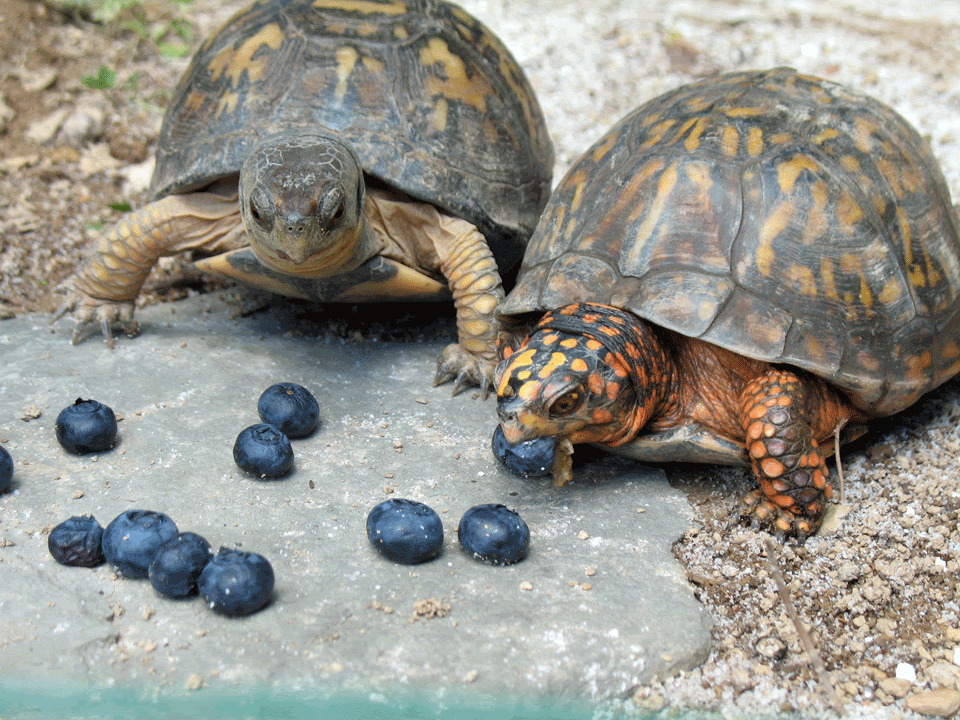


Sometimes I'll have trouble getting a new individual to eat, but when another turtle is present and eating at a distance they seem to come out of their shell (no pun intended) and feed. This is somewhat odd because Terrapene carolina are not a social species. In the wild they may not come in contact with another turtle of the same species of years even decades.
Two of my female Terrapene carolina carolina have been together for 20+ years now and actually appear to enjoy each others company. I usually have to feed all my box turtles separate (they view each other as competition during feeding time) but these two don't mind eating off the same plate right next to each other. Both these turtles were in their late teens when I got them and had probably never seen anther box turtle before. I guess because they were housed together so long that they've learned to except the fact that they are always going to be in the vicinity of each other. Plus, they get food, water and shelter so there really isn't anything to compete over.
The ladies having chat with each other.
As you can see they're pretty chill with each other even with food present.

Define social first, as some people seem to disagree on that, leading to further arguements. Reptiles certainly aren't Ivy League, but we either give them too little or too much credit as far as mental capacity. They wouldn't evolve certain behaviors if they don't benefit them in the wild, so it depends on what reptile we are talking about on whether or not being social will help their survival.
coura;2424395; said:Mucho sweetBy the way aint thouse a copple insted of 2 girls

Nope, they're both females.
i think some are but most not.... i mean they have to be to understand signals like head bobbing and things lioke such
wat about turtles and gators like so?

wat about turtles and gators like so?
