

Tank cycle question

  • We are currently upgrading MFK. thanks! -neo
Thanks for the feedback everyone. I’m just keeping the tank as is. I have an ammonia tester in there now if I don’t see any change in ammonia in the next 3-4 days I’ll do another test.

You won't see any ammonia, lol. Your tank is cycled, thanks, in part, to your addition of mature media, and very minimal stocking level.

As others have said, the only way you'll start seeing ammonia is if you add more fish too quickly.

If you do decide to add more fish, do it very gradually, and I'd maybe feed extremely minimally too for a couple of days.

Your BB will need a bit of time to increase to the new bio load. Too much of an increase and you will possibly get a slight ammonia spike.

I've been at this stage many many times and the urge is always there to add more fish into your newly cycled tank. If you are confident, and really know what you are doing, though not always advisable, you can add more fish, and through close monitoring of your parameters and partial water changes you can get by with no ammonia spikes at all.

But you really need to be in tune with your set up to pull this off without potentially putting your stock in unnecessary peril.
 
  • Like
Reactions: Azedenkae
You won't see any ammonia, lol. Your tank is cycled, thanks, in part, to your addition of mature media, and very minimal stocking level.

As others have said, the only way you'll start seeing ammonia is if you add more fish too quickly.

If you do decide to add more fish, do it very gradually, and I'd maybe feed extremely minimally too for a couple of days.

Your BB will need a bit of time to increase to the new bio load. Too much of an increase and you will possibly get a slight ammonia spike.

I've been at this stage many many times and the urge is always there to add more fish into your newly cycled tank. If you are confident, and really know what you are doing, though not always advisable, you can add more fish, and through close monitoring of your parameters and partial water changes you can get by with no ammonia spikes at all.

But you really need to be in tune with your set up to pull this off without potentially putting your stock in unnecessary peril.
Thanks for the advice. Really appreciate it.
 
A good indication that your tank is cycled is to test for nitrate. There should be nitrate present if your bacteria is converting ammonia to nitrite and then nitrate. If you don't see any nitrate, I would suspect there hasn't been enough ammonia yet for the bacteria.
As an example, I am at present fishless cycling my 450g, it has taken arround two weeks. I transfered a portion of media from my existing tank/filter and dosed the tank to 2.8mg/l of ammonia after 1 week tests showed ammonia reduced to 1.6mg/l I tested for nitrate 0mg/l. I didn't have a nitrite test kit at that time but suspect that's were the nitrogen cycle had got to. (The conversion of ammonia to nitrite then to nitrate is slow to start but should be seemless once cycled) I then redosed the tank up to 2.4mg/l of ammonia and at the end of the second week, tests showed no ammonia no nitrite and 5mg/l of nitrate. This is what you want to see.
 
  • Like
Reactions: Schniz
A good indication that your tank is cycled is to test for nitrate. There should be nitrate present if your bacteria is converting ammonia to nitrite and then nitrate. If you don't see any nitrate, I would suspect there hasn't been enough ammonia yet for the bacteria.
As an example, I am at present fishless cycling my 450g, it has taken arround two weeks. I transfered a portion of media from my existing tank/filter and dosed the tank to 2.8mg/l of ammonia after 1 week tests showed ammonia reduced to 1.6mg/l I tested for nitrate 0mg/l. I didn't have a nitrite test kit at that time but suspect that's were the nitrogen cycle had got to. (The conversion of ammonia to nitrite then to nitrate is slow to start but should be seemless once cycled) I then redosed the tank up to 2.4mg/l of ammonia and at the end of the second week, tests showed no ammonia no nitrite and 5mg/l of nitrate. This is what you want to see.
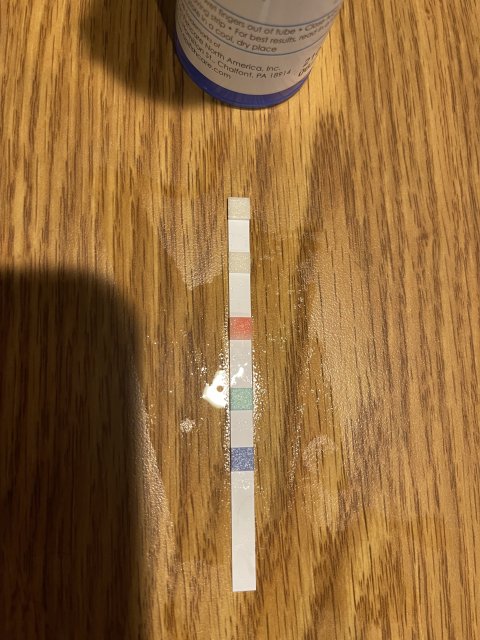
I’m thinking tank still hasn’t even started cycle then. Still not showing anything. Can see strip attached. Idk how the LFS girl said she saw small amount of Nitrate. Either I’m reading it wrong or this younger girl didn’t really know what she was looking at.

0BFA3444-ECED-40DD-B2AC-7C08CC497DA7.jpeg
 
Update just took some water back to the store and a different girl tested it and said it’s good to go.

For future reference, do yourself a huge favour and get an API liquid test kit. In my experience strips are a little unreliable, and LFS staff even more so!

Have you heard the old saying...."if you want something doing right, do it yourself!"
 
That NH3 test from SeaChem reads the NH3 toxic form only. I do not agree with how they describe the various levels of NH3. For some fish .50 ppm of NH3 can mean death or at least serious damage. Over .05 is causing problems. I would never allow near .20 ppm in any of my tanks. It is irrespondible to see .50. Here is what the Merck Veterinary manual says about ammonia and fish:

NH3 is highly toxic and frequently limits fish production in intensive systems. It is also dynamic, and when it enters the aquatic system, an equilibrium is established between NH3 and ammonium (NH4+). Of the two, NH3 is far more toxic to fish, and its formation is favored by high pH (>7) and water temperature. When pH exceeds ~8.5, any NH3 present can be dangerous. In general, a normally functioning aquatic system should contain no measurable NH3 because as soon as it enters the system, it should be removed by aerobic bacteria in the environment. Ammonia test kits do not typically measure NH3 directly but instead measure the combination of NH3 and NH4+, referred to as total ammonia nitrogen (TAN). A TAN <1 mg/L is usually not cause for concern unless the pH is >8.5. However, if the amount of NH3 is increased, an explanation should be sought. The amount of toxic NH3 present can be calculated using the TAN, pH, and water temperature. When NH3 levels exceed 0.05 mg/L, damage to gills becomes apparent; levels of 2 mg/L are lethal for many fish. Fish exposed to ammonia may be lethargic and have poor appetites. Acute toxicity may be suggested by neurologic signs such as spinning, disorientation, and convulsions.
Red added by me. 1 mg/L = 1 ppm.
From https://www.merckvetmanual.com/exot...tems?query=ammonia toxicity to fish#v23353503
 
I agree you should buy your own test kits so you can monitor the changes your self. all three NH3, NO2, and NO3 test kits are useful when cycling a new tank and monitoring whilst building your fish stock/bioload. After that the nitrate is what you will be monitoring. Remember if you have ammonia and no nitrate your tank is not cycled, simply if there is no nitrate your tank is not cycled.
 
  • Like
Reactions: tlindsey
You can get an API liquid test kit for around $20-25 online and see exactly whats going on. What size is your tank? A few neons may not be producing enough bioload to detect yet. You can cycle with something cheap and dirty like goldfish to produce the bioload to cycle it quickly then take whoever lives back to the fish store once cycled and stock with your desired fish.
 
MonsterFishKeepers.com
