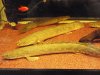
Tinkisso Guinea lapradei
- Thread starter Infblue
- Start date
You are using an out of date browser. It may not display this or other websites correctly.
You should upgrade or use an alternative browser.
You should upgrade or use an alternative browser.





Hello,
now i will take the chance to create some disturbing statement ...
I will quote Frank Schaefer who had written the one and only taxonomic book about polypterids:
" ... It (Polypterus bichir) can usually distinguished from P. lapradei by the body markings above the anal fin: This part of the body is almost always unpatterned in P. lapradei, while P. bichir exibits a pattern of light spots on a dark background ..."
OK?
If someone knows the book ( i think a "must-be" for al bichir keepers) you will see something remarkable on the few pics showing P. bichir ... they look almost like Laps - or in another way more like P. sp. koliba. The number of dorsal finlets is the same as in P. lapradei (or koliba) - there are no other markings to make a difference between lapradei, koliba and bichir ...
Almost ONE species in vivid variations?!
Another remarkable point ... another pic shows the head of a P. bichir with stunning teeth. You have to know that the pictured individual is almost 200 years old paralectotype - a bit rotten by the way. The teeth of the polypterids are embedded in fine tissue (i will do some pics of that if i've got my macro objective) that shrinks shortly after the dead of a bichir. This gives the impression of much greter teeth as they had in their lifetime ... this "trick" had found it's way to the "documentary" about snakeheads done by NG ... looks cool, spectacular and horrible, but represents not the reality.
I had e-mailed Frank Schaefer to get more answers about the Bichir-group (lapradei, koliba, bichir) but i've got no answer up to this time due to the case that Frank is too busy yet.
Greetings
Uwe
now i will take the chance to create some disturbing statement ...
I will quote Frank Schaefer who had written the one and only taxonomic book about polypterids:
" ... It (Polypterus bichir) can usually distinguished from P. lapradei by the body markings above the anal fin: This part of the body is almost always unpatterned in P. lapradei, while P. bichir exibits a pattern of light spots on a dark background ..."
OK?
If someone knows the book ( i think a "must-be" for al bichir keepers) you will see something remarkable on the few pics showing P. bichir ... they look almost like Laps - or in another way more like P. sp. koliba. The number of dorsal finlets is the same as in P. lapradei (or koliba) - there are no other markings to make a difference between lapradei, koliba and bichir ...
Almost ONE species in vivid variations?!
Another remarkable point ... another pic shows the head of a P. bichir with stunning teeth. You have to know that the pictured individual is almost 200 years old paralectotype - a bit rotten by the way. The teeth of the polypterids are embedded in fine tissue (i will do some pics of that if i've got my macro objective) that shrinks shortly after the dead of a bichir. This gives the impression of much greter teeth as they had in their lifetime ... this "trick" had found it's way to the "documentary" about snakeheads done by NG ... looks cool, spectacular and horrible, but represents not the reality.
I had e-mailed Frank Schaefer to get more answers about the Bichir-group (lapradei, koliba, bichir) but i've got no answer up to this time due to the case that Frank is too busy yet.
Greetings
Uwe

thanks jiapei! i don't really know whats the best way to ID this variant compared to a normal Guinea lapradei. it appears the color and patterning are different, it also seems to be more slender. But given the somewhat wide individual variation that occurs in lapradei, it's hard to describe in words precisely what details to look for, other than the overall 'feel'. i'm attaching a pic from a japanese site (below). the site doesn't say what it is, but i 'feel' it looks like my Tinkisso guinea lap, although i can't be 100% sure. in short, i think the best way is to combine that with reliable collection data of where the fish is imported from.jiapei;1742017; said:so infblue, u r always my expert of bichir~~~I really want to know the ID key of this variation.
thanks! its an ornate.jiapei;1742021; said:btw, is there a ornate in pic 1? that ornate is really gorgeous!!
thanks is300zx! its a guinea lap from a new river/location, as opposed to the normal guinea laps. thats my understanding.is300zx;1742080; said:nice lap. is it different from the guinea lap or are they the same?
thanks Uwe! if you ever hear from Frank, please share your findings with us!uwe;1742444; said:Hello,
now i will take the chance to create some disturbing statement ...
I will quote Frank Schaefer who had written the one and only taxonomic book about polypterids:
" ... It (Polypterus bichir) can usually distinguished from P. lapradei by the body markings above the anal fin: This part of the body is almost always unpatterned in P. lapradei, while P. bichir exibits a pattern of light spots on a dark background ..."
OK?
If someone knows the book ( i think a "must-be" for al bichir keepers) you will see something remarkable on the few pics showing P. bichir ... they look almost like Laps - or in another way more like P. sp. koliba. The number of dorsal finlets is the same as in P. lapradei (or koliba) - there are no other markings to make a difference between lapradei, koliba and bichir ...
Almost ONE species in vivid variations?!
Another remarkable point ... another pic shows the head of a P. bichir with stunning teeth. You have to know that the pictured individual is almost 200 years old paralectotype - a bit rotten by the way. The teeth of the polypterids are embedded in fine tissue (i will do some pics of that if i've got my macro objective) that shrinks shortly after the dead of a bichir. This gives the impression of much greter teeth as they had in their lifetime ... this "trick" had found it's way to the "documentary" about snakeheads done by NG ... looks cool, spectacular and horrible, but represents not the reality.
I had e-mailed Frank Schaefer to get more answers about the Bichir-group (lapradei, koliba, bichir) but i've got no answer up to this time due to the case that Frank is too busy yet.
Greetings
Uwe
i know the 'P. bichir' pics in the aqualog book you're referring to, and they do look almost like the Nigerian lapradei, except for the patterns. I have several of them, and in the US and in Asia, those are called Guinea lapradei (the live specimens in the Aqualog book were also collected in Guinea).
In my humble opinion, that's what the live specimens in the Aqualog book are, Guinea lapradei and NOT P. bichir bichir. On the other hand, I have no reason to doubt the ID of the preserved specimens in the book (collected from the Nile), and by the way i agree with you on the 'teeth effect'.
I understand we don't know every fish that's out there, but so far literature has not cited any P. bichir bichir in West Africa. In fact, i'd say we only know for sure they're found in East Africa, and comparison of the Japanese specimens (caught in East Africa) and the drawing in Gosse's paper is a very good match.
thanks channarox!channarox;1743239; said:nice lap!
love the coloration!