No Chemicals, No Medications, No Dechlorinator.

  • We are currently upgrading MFK. thanks! -neo
Hello; I rarely use water conditioners. I am lucky to have water treated only with chlorine. I fill jugs with the tap water and allow it to sit for a week or more to use for my Water changes. Don't have acid water as i live in a Karst ( limestone) area.

For decades I have only used Prime or Safe at select times. If I have to set up a tank in a hurry and use water straight from the tap I use some. If I breakdown a tank to decontaminate the tank, equipment and substrate with clorox, I use some Prime or Safe. Even after a good rinse there can be a clorox residue. I find some thorough rinsing is needed to be sure, but some Prime when the tank is first filled is also sometimes needed.
 
  • Like
Reactions: C. Breeze
I also agree with Duane, in this hobby One Size Fits All seldom applies.

I’ll never sit around and recommend my way or someone else s way or the book way- it’s real hard to make any kind of recommendation in the “general forum” as opposed to the species forums etc it gets easier to make recommendations the more specific the forum, and topic. But here- in the general forum- generally speaking- we can discuss our individual experience- the how and why of our decision making process that got us there- and then other participants can apply or discard that in there own decisions.

I recxomned that people test there water so they know what they are working with, and then treat it accordingly to render it useful for thier fish keeping, though I don’t choose to define “treat”. I encourage hobbyists to increase their understanding of all of the things that are going on in the glass box, and hopefully then apply that increased level of understanding AKA “up their game”
 
Last edited:
  • Like
Reactions: RD.
I’ll never sit around and recommend my way or someone else s way or the book way- it’s real hard to make any kind of recommendation in the “general forum” as opposed to the species forums etc it gets easier to make recommendations the more specific the forum, and topic. But here- in the general forum- generally speaking- we can discuss our individual experience- the how and why of our decision making process that got us there- and then other participants can apply or discard that in there own decisions.

I recxomned that people test there water so they know what they are working with, and then treat it accordingly to render it useful for thier fish keeping.


Well said.
 
  • Like
Reactions: C. Breeze
I really hate threads like this one as they appear to me as more BS than Poetry. Why do i say that?

One of the most amazing factors about the hobby of keeping fish is the infinite diversity of speciesavailable. this applies to the fish, the inverts, the plants and even to the decor used. But this also means that their are very few universals that can be applied. So when I read thiat this or that way is the only or the best way an alarm goes off in my head.

While what is laid out in this thread may work for one in maybe 1,000 fish keepers, for most it will be a death sentence to the inhabitants of their tanks. Let me explain with a few examples why.

1. To those who keep live plants, have you ever had a major die off in a tank? What happens if something causes a decent portion of the plants to be lost?
2. If your fish are providing all the plants need what happens when they die? Since you refuse to medicate, if you get unlucky and a disease hits do you let the fish die untrated
3. I am a keeper who wants a tankful of plant eating fish. I cannot keep plants. The system laid out here is not possible.
4. I am a keeper who wants a tankful of wild altum angels and will keep them in their natural pH close to 4.0. Oops, the method laid out here would be a death sentence.
5. I am a keeper who has managed to have 20 tanks in a limited space. 14 of these tanks are for breeding and growing out rare expensive Hypancistrus placos. None of the tanks can have live plants for logistical reasons. I must be able to catch fish regularly and do maint. and water changes easily and efficiently.
6. I am a keeper who loves working with a variety of species and I regularly change out fish. I have great connections and often get wild caught fish. These usually come with their own diseases. I do long Qs, but never in planted tanks. I treat when needed.
7. For keepers who have many tanks with a variety of species, this methodology is simply not practical nor, for most, cost effective.
8. The tap water parameters across the world are far from being similar. This can even apply to the parameters in systems only miles/kilometers apart.

As was noted in this thread fish in a box v.s. fish in the wild are completely different things. Nobody does water changes, nobody feeds, nobody medicates fish in the wild. Nobody dechlorinates the water, nobody cleans filters etc. etc. This is all done by nature. In a glass/acrylic box, we do almost all of this.

I would challenge the OP to run my system the way he describes. I failed to mention that for many summers I would set up anywhere from 4 to 10 tanks. ranging in size from 10 to 50 gallons,. outdoors on our screened terrace. These tanks went up when the nighttime temps were staying in the mid 50sF or above and came down when the reverse began, I can keep tanks up foe one or two nights in the low 50s but not colder. The tanks normally come down in late Sept into early Oct.

These tanks are used to Q new fish, to grow out fish born in my tanks and to segregate offspring for sale. Many of these tanks are bare bottom.

Here is the thing- I have done all of the things that this thread wants to avoid and have had decent success over the years. My hobby pays for itself from the spawns I get. I did a high tech planted tank with injected pressurized co2 for over a decade. It was so much work compared to my other tanks that I finally took it down. It was also one of the healthiest tanks I had and I added ferts regularly. The one thing I never have to use in my tanks is dechlor, We have our own well with amazing water. Its is neutral pH and 83 ppm TDS. Soft water fish thrive in it and many fish breed in it. I like to tell people it contains a natural fish aphrodisiac.

I can also say the probably the least understood aspect of a healthy tank system is the level of dissolved oxygen in the water. Much of the bacteria and all of the critters we keep in our tanks need oxygen.

Here is my take on what this thread should have started out by saying:

If you keep a tank that can support live plants, if you are willing to chose fish that can thrive in such a tank, then here is a method that I have developed over the years that works very well for me. Anybody who says you can do tanks without dechlor, without ferts for plants and without ever using any meds or other chemicals doesn't apparently grasp the scope of the hobby.

But one also must realize that there are basically two types of fishkeepers. One will have only one or maybe two tanks. They will do simple hardy fish and maybe easy live plants. If they make it past the initial learning phase they may have their tank or tanks for many years and only add new fish when they lose an existing one.The there are those of us who suffer from MTS. We live by the saying, "So many tanks and so little time. Since you cannot get more time you may as well get more tanks." When people hit that level things change. A whole new world opens up and the possibilities are limitless.

What I learned a long time ago and which is one of the few universals in the hobby is the advice that it is much easier to keep fish which will be "happiest" in your water parameters. If you want to keep fish not in that range, then you must be 100% certain your tank set-up meets the meets of the fish. This can mean you must have live plants or it may mean the reverse. There are very few universal in this hobby:
1. Fish must be kept in water.
2. Fish must be fed.
3. Fish must be kept in conditions that are not detrimental to their survival and their ability to thrive in captivity. That is, we must provide them with conditions/paremeters they need for this.

The variety comes in what we choose to keep and in how we choose to accomplish #3 the above.

Also, I am extremely doubtful that one could have say five such tanks as described by the OP and have them all thrive, never get any disease etc. or imbalances that need to be addressed and never need dechlor. I consider the OP's tank to be an exception and nowhere near being the norm. I also doubt that he is able to keep a many of species of either fish or plants that others of us may in his tank.

BTW- chlorine/chloramine in our tanks is way more dangerous to the fish and inverts than to the established nitrifying bacteria.

As for adding chemicals. I have used Flourish Excel in most of my planted tanks for many years now, I have healthy large clown loaches now for over 18 years is such a tank from day one. They have thrived and my only beef is they love to chew on my anubias. But i forgive them for being such pigs. They are always at the surface when the food hits the water.

One last though here. Most sellers of fish do have to deal with diseases. parasites etc. This is true of the hobby breeder all the way up to the fish farmers. It is simple, the more fish you have coming into a system, the greater the chance that something will bring in problems. I can assure you that as the fish travels from where it was born to its final destination in our tanks, it has been through dechlor, medication, and likely other chemicals before you get it. I breed and sell fish and sometimes I have issues I have to treat. I never let unhealthy fish carrying anything go out. What this means is even if one has a system that gets no dechlor, ferts or chemicals gets fish that have already been exposed to one or more of these things.

Some of my tanks contain fish worth many 1,000s of dollars. My approach is a lot different than the OPs. But if it works for his tank, then good for him. However, this method will never work for most of my tanks.
 
All I am going to respond to is this…. Cuz it cracks me up every time.

“my fish eat plants, so I can’t keep plants with them”

what? Doesn’t that mean you need to keep plants with them? I don’t know.

i do know that 90% of my fish eat plants. Defintely another reason I have lots of them….

Edit… changed my mind, I’ll reply to the logistics issue also, it takes me about 72 seconds longer to bag up and box 5-10 dozen fish when I have to pull the plants before I net the fish than it does when I don’t have to put the plants in a bucket first.

…but I charge the customer for that extra 72 seconds of my time so it’s a wash.
 
Last edited:
I sell Hypancistrus plecos. In order to catch these one needs to either have a very specific set-up which requires a lot more space than I have or else one must remove everything but the plecos in a tank to be able to catch them. These are fish that are hard wired to hide. There are times when I even have to detach the heaters from the glass to catch them.

All of the plecos I breed come from the same place, the Big bend of the Rio Xingu in Brazil. They live in fast flowing and/or deep water where there is little or no plant life. I realize some people may not be aware that some fish do not come from waters with plants. Some people do not know there are other ways to get plant matter to their fish. The ones I breed tend to need some plants/algae matter when very young. I get it to them in other ways that meet their needs. In the wild they must go near the surface or open waters to find this and that exposes them to predators they cannot avoid. One can also feed things like veggies to plant eaters as well- squash, cucumber, sweet potato etc. keeping plant eating fish means limiting the type of plants one can keep.

What makes this hobby so much fun is the variety of just the FW fish we might keep. Unlike the oceans, which tend to be more uniform in their parameters, FW varies a great deal.

But for the OP of this thread catching fish is something they apparently never do. I do not think the OP sells fish and, since they do not ever get sick, there is no need ever to catch a live fish. I assume when one finally dies of old age it is easy to remove.

Like I have said myriad times, this hobby offers a ton of choices. What we choose, what we can spend andr the space we have available determines how we should do things. My house has no basement, so I cannot have a fish room. My tanks are in two buildings and 4, and sometimes 5, different rooms.

With an apology to the OP and other participants and readers here......

I will issue a challenge to C. Breeze. I will make it interesting. I will bet C. $100 that you cannot come here and net out 10 specific size pleco offspring from one of my breeder or grow out tanks, get them bagged and return the tank to normal in 30 minutes. In fact you will not be able to do it in twice that time. Most of those tanks are 33 longs. If C. is so inclined, I am willing to make the bet much bigger. I will even go one step further. If C. is far away and needs to travel a bunch to get here, I will cover C.'s reasonable travel expenses both ways as well if C. wins the bet.

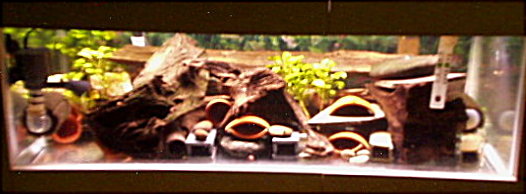
I am nothing but fair, before you accept look at the pic below. It is a 30 gal. breeder tank and is the first tank for breeding zebra plecos I had. I put into it a group of 13 proven breeding zebra plecos and 5 of their offspring I had purchased. They began spawning for me fairly fast. When I did my first fry hunt in that tank I removed 53 offspring. I am sure C. could break down that tank, nab 10 offspring at a specified size and put the tank back together in only 3 hours. People who would visit and look at my tanks would get to this tank and routinely ask why there were no fsh in it despite the fact that there were 50-60 zebras in there.

Sorry, back then I had a really hard time taking decent whole tank pics, but you get the idea. The live plants were there because it was a new tank in terms of the fish coming in. A smaller fish load went out than came in. I removed the plants not long afterwards.

i-bQhtW8w.jpg
 
Anybody who says you can do tanks without dechlor, without ferts for plants and without ever using any meds or other chemicals doesn't apparently grasp the scope of the hobby.

That totally depends on a number of factors. Dechlor - a non issue for some folks. (I'm not one of them) No need to add dechor if the chlorine residual coming out of ones tank is .01%, and they are changing out small amounts of water. Heck at that residual level, by the time the water leaves the faucet aerator it could easily be 0.0 chlorine. So why would that particular person need dechlor??? Obviously they would not. By the time the new water meets the organics in the tank water, it's a done deal. Even with chloramine, and a drip system, if the daily dose is small enough in volume, spread out over 24 hours, there is no need to add a reducing agent, for the same reason. Chlorine reacts with the organics, the chlorine/ammonia bond is broken, and the ammonia spike is no more than if the owner tossed a shrimp in for his fish. In a well balanced system, the bio-bacteria and/or plants take care of it, the same as if it was produced by the fish or food.

Ferts - again depends on the plants, the stocking/feeding overall nutrient levels in the tank, and what one is attempting to achieve. If ones stock is all healthy, and been in the same tank for years - meds become a non issue. I can't recall the last time that I used meds, or even salt, in one of my tanks.

Again - one size does not fit all.

I can't get away with no dechlor, but some folks can, and do, and have very successful set ups thriving for years.
 
Last edited:
In my particular case the goal is healthy tanks/systems/fish.

the idea that I need to buy a reagent to use in order to effect a chemical reaction, that is going to happen anyway, on contact with “stuff” (I’m being intentionally vague, and broad in my use of that term) of the kind that’s already in my tank, ie driftwood, plants, algae, detritus etc, strikes me as superfluous.

going back to the winter tanks I just set up- I could go buy a bottle of dilute sodium thiosulfate solution or buy the crystals and mix my own to add. At which point I’d still have to add the plants etc that makes the system work. It’s just as effective to add half the plant mass (or a big piece of driftwood, or some lemon juice, or rinse off some lettuce , throw in a handful of topsoil, etc etc etc) to the straight Tap water in order to render it safe. So at that point I ask- what’s the point of the sodium thiosulfate- if it is superfluous, it’s superfluous. It can’t replace the plants in a system but I can use almost anything else that is “dirty” to do it’s job.


Back To Chloramine- which I think for most (those who don’t know if they face it and those who know they do) hobbyists is the real sticking point.

the very things that make chloramine more difficult to address in and aquarium are the same “attributes” that make it less desirable for water Treatment than chlorine- mainly the fact that it is more stable and difficult to unbind the constituent components.

plants are great at this, as well as really good at utilizing the ammonia / ammonium that is released. I would rather deal with chloramine in a separate planted system without additional reagents than by double dosing with sodium thiosulfate (the common advice) in my tank when conducting a partial water change. The double dose of sodium thiosulfate will bind up O2 in the water column, while releasing ammonia into the water column.
Or even worse- it won’t actually break the chlorine/ ammonia bond and you’ll still be relying on the organic matter in your tank to do the heavy lifting.
You can use dechlor to react with the chlorine before it hits your tank. Sure in-tank organics can react with it, but this includes your fish. It's so cheap and harmless I really don't see the point in cutting it out.

0h snap- it’s the bio farmer. Hahahahaha. Don’t you have some sponges to try to cycle or something?
Poeetry? No, just a candid discussion about biological and chemical processes in an unsealed but “contained” ecosystem.

the only thing I know about your methods and system is that they are so complex and convoluted that you can’t even make them work when you attempt to do a tutorial thread. I like that you always post your full resume though, it reassures me that if the subject matter expert can’t make his system work- there’s no need for me to waste my time. Do you want to link to your “bio farm” thread or should I? Should I post links tonall
My various breeding threads including species that are new collections, undescribed, not yet in the hobby etc? You kill me.
Don't resort to character assassination, same goes to you TwoTankAmin TwoTankAmin
Having new or undescribed species to the trade is more a thing of access than anything.


What I am struggling to comprehend about this is how cutting out the basic chemicals used in aquaria leads to "healthier" fish. You generally use prepared foods, non-natural internal ecosystems, reducing seasonal changes, generally allow higher-than-normal levels of pollutants, the list goes on. Even plant fertilisers, really?

as RD. RD. said, no shoe fits all, hell I grow high tech plants with co2 but far less ferts than recommended, and it's more or less balanced. But the blatant promotion of no-chemical tanks is hazardous for those without the experience to make them work. A lightly stocked 150gal will be far more forgiving than a 10 gallon.

Back when my dad kept fish at my age, he did not have access to a lot of the bottled creature comforts that we have in proper aquarium products, and lost many fish as a result! This would be better discussed as a potential method to play with and not gospel. It took years to get the hobby over tiny water changes, don't drag it down again.
 
Phew,

I will try and answer some of the points.
Rift lake Cichlids: The only issue is the Alkaline water, I run the Rift Lake cichlids on a lime chip substrate, and have plants in their tank the same as with Oscars, I have their tank planted, Silver dollars I use the aquatic plant that is produced from the other tanks to feed them but also for adsorption of chlorine.
I run under gravel filters that work on an air lifter so they are passive and my substrate is always open enough so that the base of the tank becomes part of the filter system.
I never add anything to my tanks apart from fresh water, I am very particular about mixing species of fish.
My water changing method is 25% weekly using a garden hose with a spray nozzle, by the time the water hits the tank almost all the chlorine has dispersed, I believe that the 4 degree temperature drop on the tank is beneficial for the fish.
The trend towards sand substrate in tanks I don't think is helping the plants or the fish, I like to find fine gravel from a natural source for all my tanks.
 
  • Like
Reactions: C. Breeze
You can use dechlor to react with the chlorine before it hits your tank. Sure in-tank organics can react with it, but this includes your fish. It's so cheap and harmless I really don't see the point in cutting it out.


Don't resort to character assassination, same goes to you TwoTankAmin TwoTankAmin
Having new or undescribed species to the trade is more a thing of access than anything.


What I am struggling to comprehend about this is how cutting out the basic chemicals used in aquaria leads to "healthier" fish. You generally use prepared foods, non-natural internal ecosystems, reducing seasonal changes, generally allow higher-than-normal levels of pollutants, the list goes on. Even plant fertilisers, really?

as RD. RD. said, no shoe fits all, hell I grow high tech plants with co2 but far less ferts than recommended, and it's more or less balanced. But the blatant promotion of no-chemical tanks is hazardous for those without the experience to make them work. A lightly stocked 150gal will be far more forgiving than a 10 gallon.

Back when my dad kept fish at my age, he did not have access to a lot of the bottled creature comforts that we have in proper aquarium products, and lost many fish as a result! This would be better discussed as a potential method to play with and not gospel. It took years to get the hobby over tiny water changes, don't drag it down again.


I don’t know what to tell you,
A) I’ve mentioned a couple experiments a hobbyist can perform for themsleves to validate or invalidate the method with there own water supply

B) I’ve never suggested or recommended
anything other open minds, eyes, and critical thinking.

C) I personally perform, and have described such, multiple 30% water changes a week, unless performing daily 10% changes- hardly discouraging water changes

D) I’m talking about being particular about maintaining a high and varied population of single celled life- you know, the fragile ones in the system. If we accept that the purpose of the additives in tap water is to prevent the development of single celled life forms- and atr reducing it effectively enough to maintain diverse cultures of algae’s and other “fry food” etc…. If we aren’t killing fish eggs, and of we aren’t losing fry… you can bet the big ones will be ok too


There’s been a ton of talk about co2 and fertilizers etc- and I don’t know anything about that- it’s the antithesis of what I’m about. I’m not trying to develop a false carrying capacity- and potential “crash” that comes when you fail at walking the tight rope that your out of wack tank is.
I’m maintaining the most balanced and diverse ecosystems I can, and enjoying the success that follows with a complete, robust, and resilient ecosystem

I know a lot of keepers like chasing a particular color in the test tube or whatever- and I guess you can measure success like that, but more importantly you might even be able to achieve satisfaction with the hobby that way- but it bores me.
 
Last edited:
  • Like
Reactions: 2Itiwhetu
MonsterFishKeepers.com