


Basic Aquarium Filtration misunderstanding
- Thread starter duanes
- Start date
You are using an out of date browser. It may not display this or other websites correctly.
You should upgrade or use an alternative browser.
You should upgrade or use an alternative browser.
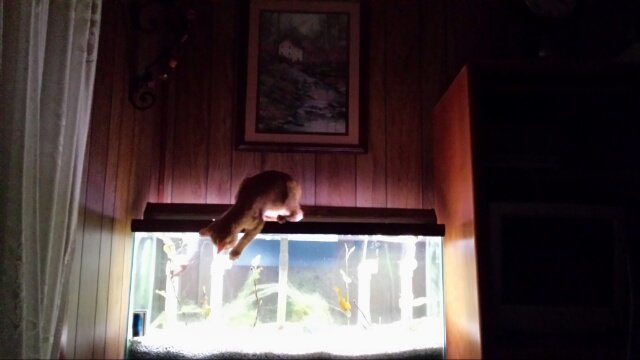


The discussion involved the use of growing Pothos, on top of an aquarium. To maintain water conditions. Which is poisonous to cats.

...
When the biological media in a filter is sized properly for the fish the tank, it will serve to remove toxic ammonia and nitrite, and help to covert those toxic substances to, or store “less toxic”
...
From your statement above, how does the biological media "remove" the toxic ammonia and nitrite? Don't the bacteria only "convert" from one form to the next by breaking the bonds between oxygen, hydrogen, and nitrogen?
This is a good thread, thanks for starting it.

From your statement above, how does the biological media "remove" the toxic ammonia and nitrite? Don't the bacteria only "convert" from one form to the next by breaking the bonds between oxygen, hydrogen, and nitrogen?
This is a good thread, thanks for starting it.
Ammonia is consumed as a food source. The byproduct or waste is nitrite. Nitrite is then converted to nitrate.

The thing to remember when we talk about the nitrogen cycle is, nitrate doesn't go away unless it is consumed by either additional bacteria (anaerobic)or plants.
Anaerobic bacteria will consume nitrate and produce nitrogen. Plants will produce oxygen and carbon dioxide.
The process is cellular and molecular and totally invisible. Thats why, when a filter manufacturer makes claims without disclosing the dangers of nitrate accumulation in favor of high flow rates and massive mechanical filtration, they are doing a disfavor to the average aquarist who may not know about the clear and present danger.....and I'm not talking about a Tom Clancy novel-made-movie starring Han Solo......a person can have absolutely crystal clear water, 0 ammonia and still have chemicals in the water that are harmful.
Anaerobic bacteria will consume nitrate and produce nitrogen. Plants will produce oxygen and carbon dioxide.
The process is cellular and molecular and totally invisible. Thats why, when a filter manufacturer makes claims without disclosing the dangers of nitrate accumulation in favor of high flow rates and massive mechanical filtration, they are doing a disfavor to the average aquarist who may not know about the clear and present danger.....and I'm not talking about a Tom Clancy novel-made-movie starring Han Solo......a person can have absolutely crystal clear water, 0 ammonia and still have chemicals in the water that are harmful.

I agree, that ammonia and nitrite in reality, are only converted to nitrate.
But I used the word removed, as a simple way of putting that those substances are mostly removed as toxic danger to the fish.
I believe filtration is most often misunderstood, especially by noobs, where it is seen as a kind of panacea, where a filter is often turned on, and until it backs up, or fish die, is forgotten about.
I am also trying to break the process down into a form where its complexity is described in enough detail to be payed attention to, but not so that the new aquarists eyes (and attention span) are glassed over with a myriad of technical terms, and at the same time,without being overly dumbed down.
Another point.
I often see that many new aquarists think the beneficial bacteria are free floating in water, and they will transfer old water to a new tank, thinking that is a way of cycling it.
This is not the case.
99.9% of beneficial are sessile, meaning they live attached to something.
The glass sides, the substrate, the biological media, plants, but not as plankton in the tank water. Using old water could be a shock buffer, if tap water is drastically different from tank water, due to a lack of water changes allowing the tank to acidify, or temperature regulation, but is really of "no" use in cycling a tank.
But I used the word removed, as a simple way of putting that those substances are mostly removed as toxic danger to the fish.
I believe filtration is most often misunderstood, especially by noobs, where it is seen as a kind of panacea, where a filter is often turned on, and until it backs up, or fish die, is forgotten about.
I am also trying to break the process down into a form where its complexity is described in enough detail to be payed attention to, but not so that the new aquarists eyes (and attention span) are glassed over with a myriad of technical terms, and at the same time,without being overly dumbed down.
Another point.
I often see that many new aquarists think the beneficial bacteria are free floating in water, and they will transfer old water to a new tank, thinking that is a way of cycling it.
This is not the case.
99.9% of beneficial are sessile, meaning they live attached to something.
The glass sides, the substrate, the biological media, plants, but not as plankton in the tank water. Using old water could be a shock buffer, if tap water is drastically different from tank water, due to a lack of water changes allowing the tank to acidify, or temperature regulation, but is really of "no" use in cycling a tank.

The thing to remember when we talk about the nitrogen cycle is, nitrate doesn't go away unless it is consumed by either additional bacteria (anaerobic)or plants.
Anaerobic bacteria will consume nitrate and produce nitrogen. Plants will produce oxygen and carbon dioxide.
The process is cellular and molecular and totally invisible. Thats why, when a filter manufacturer makes claims without disclosing the dangers of nitrate accumulation in favor of high flow rates and massive mechanical filtration, they are doing a disfavor to the average aquarist who may not know about the clear and present danger.....and I'm not talking about a Tom Clancy novel-made-movie starring Han Solo......a person can have absolutely crystal clear water, 0 ammonia and still have chemicals in the water that are harmful.
Yeah I remember reading about this and learning about inhibiting factors for breeding. A lot of times people do water changes myself including to mimic the rainy season so they can spawn until I found out from this article talking about how they're properties in the tank that can inhibit the actual pheromones and breeding will not be successful. So just doing water changes has a lot of beneficial factors for it.
I need to do a water change on my tank in two days I know the cycle in my breeding tank and every two weeks so I do it the day before and the next night I'll have eggs.

Unless the aquarist purges the media of this stuff, it is still in the system, and still in the tank, unless removed by water changes, or some other chemical reactor, or substance.
In my filtration plant work, biological filters needed to be backwashed every 5 days, otherwise non-beneficial bacteria would proliferate, and particles would break through, which lead to a lessening of filter efficiency.
The most common misuse of filters is to store waste in ,and not remove waste away, from the system. The right way to manage a filter is to clean the media frequently to optimize growth of beneficial (nitrifying) bacteria, rather than to promote growth of non-beneificial (heterotrophic) bacteria that compete with fish and beneficial bacteria for oxygen.
Unless you grow plant, WC is the easiest and sure way to remove nitrate in a freshwater tank. In salt water, many aquairists use the Berlin live sand/rock system to complete the nitrogen cycle with denitrification. Most wastewater treatment plants just dump nitrate rich water into our waterway that feed algae. Advanced sewage treatment plants employ tertiary treatment that convert nitrate to nitrogen by anaerobic denitrification process.
I agree, that ammonia and nitrite in reality, are only converted to nitrate.
But I used the word removed, as a simple way of putting that those substances are mostly removed as toxic danger to the fish.
I believe filtration is most often misunderstood, especially by noobs, where it is seen as a kind of panacea, where a filter is often turned on, and until it backs up, or fish die, is forgotten about.
I am also trying to break the process down into a form where its complexity is described in enough detail to be payed attention to, but not so that the new aquarists eyes (and attention span) are glassed over with a myriad of technical terms, and at the same time,without being overly dumbed down.
Another point.
I often see that many new aquarists think the beneficial bacteria are free floating in water, and they will transfer old water to a new tank, thinking that is a way of cycling it.
This is not the case.
99.9% of beneficial are sessile, meaning they live attached to something.
The glass sides, the substrate, the biological media, plants, but not as plankton in the tank water. Using old water could be a shock buffer, if tap water is drastically different from tank water, due to a lack of water changes allowing the tank to acidify, or temperature regulation, but is really of "no" use in cycling a tank.
"Dumbing it down" isn't necessarily a bad thing. I wish I had a forum (and internet) back when I was young in the hobby. I wish I had a better understanding of the cycle before so many fish had to die. The books and such available at the time weren't very clear.....a lot of scientific terminology. ..and no Google. I think you hit a good point about filters and the way they are marketed. Take Eheim for example. A very reputable company with decades in filtration technology but I haven't, at least to my recollection, never seen the cycle explained in any of the filter user guides. Most manufacturers could assist with some much needed information regarding what to expect from theirs or any filter for that matter. It really does make a difference in how an aquarium is kept and why a filter works the way it does......and conversely. .....how it doesn't or won't.
