


I think this is great advise. smaller jobs are likely to be taken on waaaaaay more frequently than great big jobs. I know on my hob filters, I can easily yank the sponge and give it a good rinse and I'm good for another week or 2. with my fx6 I have to disconnect the hoses and carry this thing full of water to the tub and then I can do my maintenance. obvs there are ways to make even this process easier but I really like the idea of having instead of 1 big canister having 2 slightly smaller hob filters. or even better if you can handle the bubbling, 4 big sponges or something.The right way to maintain good water quality is to do frequent WC and frequent filter media cleaning. This is why I prefer small capacity HOBs over large capacity canisters which force me to clean the media frequently.
Basic Aquarium Filtration misunderstanding
- Thread starter duanes
- Start date
You are using an out of date browser. It may not display this or other websites correctly.
You should upgrade or use an alternative browser.
You should upgrade or use an alternative browser.
One of my favorite topics!
Some people will claim to their last breath that filters - cakes with waste, uneaten food and whatever gets sucked into them - only need to be cleaned when their flow slows or they clog.
I'm a big fan of frequently cleaning mechanical filtration to remove nasty stuff from the system.
I've virtually eliminated canister filters from my fishroom because cleaning the mechanical media regularly is a PITA...which means I don't do it frequently enough.
Almost all of the tanks in my fishroom have an air-driven box and sponge. I run the boxes with filter fluff and lots of air (to serve as mechanical filtration) and the sponges with less air (to be primarily bio). I clean the fluff in the boxes weekly or more often and squeeze out sponges regularly.
I'm also a fan of Pothos, which I've used in a garage fishroom frequented by cats without incident.
Would love to get Duane's perspective on Poret foam, which is kept in place pretty much indefinitely. I use it as a divider on some tanks and try to clean it during water changes. People argue that the stuff in it is inert. I'm not so sure...
Matt
Some people will claim to their last breath that filters - cakes with waste, uneaten food and whatever gets sucked into them - only need to be cleaned when their flow slows or they clog.
I'm a big fan of frequently cleaning mechanical filtration to remove nasty stuff from the system.
I've virtually eliminated canister filters from my fishroom because cleaning the mechanical media regularly is a PITA...which means I don't do it frequently enough.
Almost all of the tanks in my fishroom have an air-driven box and sponge. I run the boxes with filter fluff and lots of air (to serve as mechanical filtration) and the sponges with less air (to be primarily bio). I clean the fluff in the boxes weekly or more often and squeeze out sponges regularly.
I'm also a fan of Pothos, which I've used in a garage fishroom frequented by cats without incident.
Would love to get Duane's perspective on Poret foam, which is kept in place pretty much indefinitely. I use it as a divider on some tanks and try to clean it during water changes. People argue that the stuff in it is inert. I'm not so sure...
Matt

Could you please elaborate on the negative side effects of nitrate? I heard everything from completely harmless to deadly in large quantities . Wanted to know your take on this with your experience?I am not recommending any one type over another, because basically, they all do the same thing.
Cleaning them often, is more important in my eyes than the type.
I do think being user friendly is also very important.
If its difficult or time consuming to clean, it will not be done.
I like sponges because they can be cleaned often, with little effort.
I also like HOBs because the mechanical media can be cleaned in a few minutes without turning them off, although as I said in my first post, if there is a 10" oscar in a 75 gal tank, and they are the type, the entire back of the tank should be a lined with HOBs, (maybe the sides too) and at least one (if not more)should be cleaned "daily".
But in my fishroom, I preferred sumps with filter socks as mechanical, and bio-fractionation for chemical and biofiltration. Fractionators need a lot of constant tinkering, and because I had 1000 gallons in tanks, and also that much more in ponds, the bio tubes were 4ft tall and 8" in diameter, so not recommended for the average aquarist.
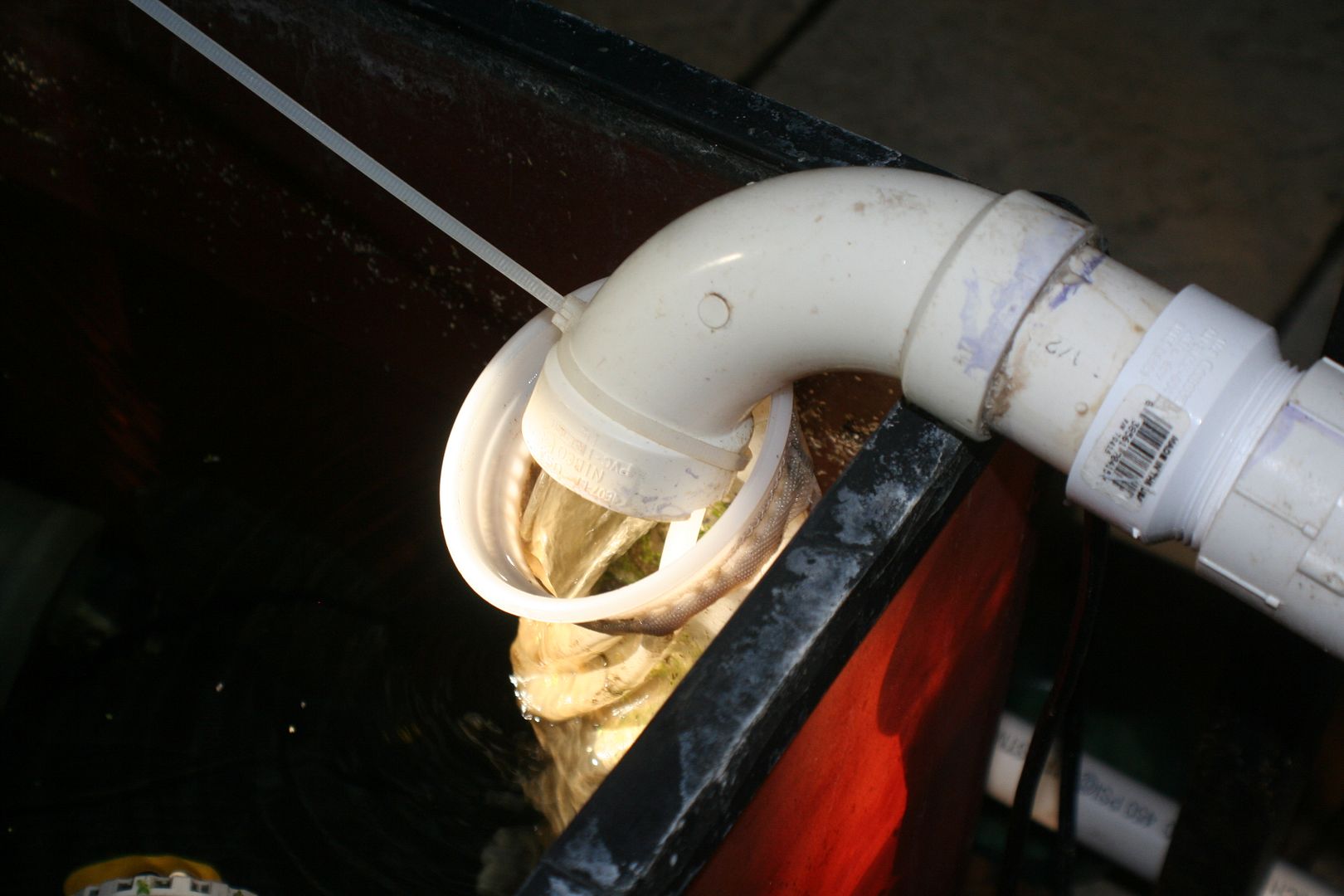
below is waste pulled out of the water column, by a bio-fractionator


 Empyreal
nitrate, to my knowlege, is harmless at low quantities but can start causing issues when it gets higher.
Empyreal
nitrate, to my knowlege, is harmless at low quantities but can start causing issues when it gets higher.I clean all my media in tankwater every week to maintain efficiency so in my aquaclear 11 i cut the sponge in half to fit in additional matrix media for maximum bio and it doesnt cause issues because i clean it every week.
Also a large flow rate is great but media needs to be clean to make it as efficent as possible


I have never used Poret foam, so I'm not qualified to comment.
I believe nitrate is "not" harmless.
Much of the aquaculture research suggests any concentration over 20ppm is causes stress, and because stress is one of the main factors to lead to fish disease, especially chromic issues, that hardly seems harmless.
There is also some research, (and sorry I lost the link) that suggests that high nitrate allows a substrate to form on the fish that provides bacteria an easier pathway to cause problems.
And when you consider that most natural waters are very low in nitrate, the concentrations suggested as OK for aquariums seems short sighted to me.
When I worked s a water chemist/microiologist, part of my job was to test raw lake Michigan water for the presence of nitrate, and the tests always averaged < 1.00ppm.
I believe nitrate is "not" harmless.
Much of the aquaculture research suggests any concentration over 20ppm is causes stress, and because stress is one of the main factors to lead to fish disease, especially chromic issues, that hardly seems harmless.
There is also some research, (and sorry I lost the link) that suggests that high nitrate allows a substrate to form on the fish that provides bacteria an easier pathway to cause problems.
And when you consider that most natural waters are very low in nitrate, the concentrations suggested as OK for aquariums seems short sighted to me.
When I worked s a water chemist/microiologist, part of my job was to test raw lake Michigan water for the presence of nitrate, and the tests always averaged < 1.00ppm.
One of my favorite topics!
Some people will claim to their last breath that filters - cakes with waste, uneaten food and whatever gets sucked into them - only need to be cleaned when their flow slows or they clog.
I'm a big fan of frequently cleaning mechanical filtration to remove nasty stuff from the system.
I've virtually eliminated canister filters from my fishroom because cleaning the mechanical media regularly is a PITA...which means I don't do it frequently enough.
Almost all of the tanks in my fishroom have an air-driven box and sponge. I run the boxes with filter fluff and lots of air (to serve as mechanical filtration) and the sponges with less air (to be primarily bio). I clean the fluff in the boxes weekly or more often and squeeze out sponges regularly.
I'm also a fan of Pothos, which I've used in a garage fishroom frequented by cats without incident.
Would love to get Duane's perspective on Poret foam, which is kept in place pretty much indefinitely. I use it as a divider on some tanks and try to clean it during water changes. People argue that the stuff in it is inert. I'm not so sure...
Matt
Right there with you. I used to run a FX5 on my 75g and it was a chore. When I upgraded my 75g I moved to 3 AC110s where I cut the sponge in half and can actually fit more bio that my FX5. Doing quick changes is much easier now. I will say though that I was heavily understocked (1 10in rhom) and if you overstock the HOB aren't really an option.
Filters shouldnt be rated for a certain size tank, you just need a balance of flow rate and media based partially on tank size and what you stock and what you feed.
For example with my 70gallon tank I could of got an aquaclear 70 'rated' for a tank my size but instead payed more for the aquaclear 110 for lots more flow and media space because I am keeping a 3 medium predatory fish that will have a good amount of bioload
For example with my 70gallon tank I could of got an aquaclear 70 'rated' for a tank my size but instead payed more for the aquaclear 110 for lots more flow and media space because I am keeping a 3 medium predatory fish that will have a good amount of bioload
Nitrate is definitely harmful to fish, even in low quantities. Think of it sort of like air pollution for humans. Less is always better than more. There are lots of strategies to reduce nitrates but water changes, (terrestrial and aquatic) plants and proactive removal of mechanical waste are the simplest.

Here is a good read on biological filtration from aquaculture perspective.
http://biofilters.com/webfilt.htm
“In general, there are two types of aerobic microorganisms that colonize biofilters for aquaculture. Heterotrophic bacteria utilize the dissolved carbonaceous material as their food source. Chemotrophic bacteria such as Nitrosomonos sp. bacteria utilize ammonia as a food source and produce nitrite as a waste product. Chemotrophic bacteria such as Nitrospira sp. utilize nitrite as a food source and produce nitrates as a waste product. Nitrosomonos and Nitrospira will both grow and colonize the biofilter as long as there is a food source available. Unfortunately, both of these types of bacteria are relatively slow growing. Heterotrophic bacteria grow about 5 times faster and will out compete the other two types for space if food is available. Since most aquaculture biofiltration systems are designed for the purpose of converting and removing ammonia from the water this presents a problem. “
The scum built up in the media is largely non-beneficial heterotrophic bacteria which compete with BB for oxygen and space. Allowing the filter to scum up not only reduces its biological efficiency, but can become a time bomb in extended power outage.
http://biofilters.com/webfilt.htm
“In general, there are two types of aerobic microorganisms that colonize biofilters for aquaculture. Heterotrophic bacteria utilize the dissolved carbonaceous material as their food source. Chemotrophic bacteria such as Nitrosomonos sp. bacteria utilize ammonia as a food source and produce nitrite as a waste product. Chemotrophic bacteria such as Nitrospira sp. utilize nitrite as a food source and produce nitrates as a waste product. Nitrosomonos and Nitrospira will both grow and colonize the biofilter as long as there is a food source available. Unfortunately, both of these types of bacteria are relatively slow growing. Heterotrophic bacteria grow about 5 times faster and will out compete the other two types for space if food is available. Since most aquaculture biofiltration systems are designed for the purpose of converting and removing ammonia from the water this presents a problem. “
The scum built up in the media is largely non-beneficial heterotrophic bacteria which compete with BB for oxygen and space. Allowing the filter to scum up not only reduces its biological efficiency, but can become a time bomb in extended power outage.
Im having a home filtration installed and was wondering if they can make nitrate removal filters on a large scale is there a reason why they havent been mass produced on auch smaller scale ?
