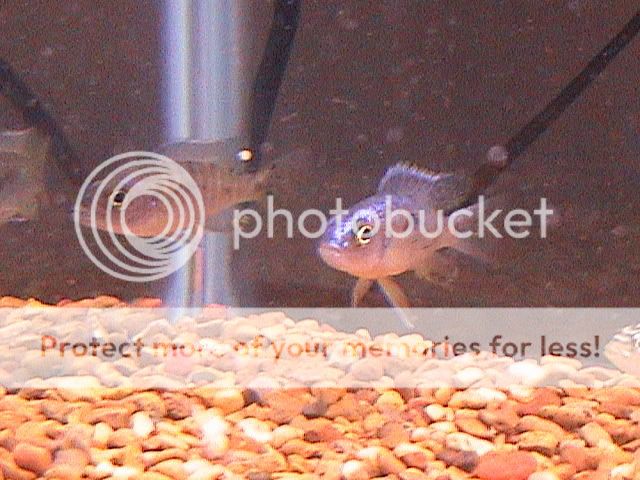
Blue Ahli (male/female)

  • We are currently upgrading MFK. thanks! -neo
mike dunagan;769030; said:
It will take a little research and practice, but you are looking to see their sex organ holes in common words.

is a good site to show me what to look for or how to do it? how old do you think they should be?
 
straitjacketstar;763486; said:
It would help if you looked the correct name for the fish which is Sciaenochromis fryeri.
Hap. ahli is an old trade name for this fish which is incorrect and is actually the name of another (less brilliantly colored) fish of the same genus, Sciaenochromis ahli.

I believe the name Sciaenochromis ahli is no longer valid, as Sciaenochromis fryeri is the now accepted name for the species. Prior to being labeled S. ahli the species was classified as Haplochromis ahli, however S. fryeri is the only correct one.

They're very interesting fish but believe they do best in LARGE tanks even upwards of 100G as the male, if dominant will try to establish a huge territory. I've read that breeding is very achievable though, good luck.
 
TicaL;769567; said:
I believe the name Sciaenochromis ahli is no longer valid, as Sciaenochromis fryeri is the now accepted name for the species. Prior to being labeled S. ahli the species was classified as Haplochromis ahli, however S. fryeri is the only correct one.

They're very interesting fish but believe they do best in LARGE tanks even upwards of 100G as the male, if dominant will try to establish a huge territory. I've read that breeding is very achievable though, good luck.

S. ahli and S. fryeri are two different fish ;) . S. fryeri was erroniously being labelled S. ahli or Hap. ahli. Previous name for S. fryeri was Hap. jacksoni I believe (now invalid).
While S. ahli is the wrong name for S. fryeri it is a valid name for a different species within the same genus.

Same scenario for other fish that look similar but get sold as something else. Like Cichlasoma urophthalmus sold as Amphilophus festae, Aequidens sp. Goldsaum sold as A. rivulatus, Parachromis loisellei sold as P. friedrichsthalii, Trichopsis schalleri sold as T. pumilla, Betta imbellis sold as Betta splendens or Mesonauta insignus sold as M. festivus.
 
truthfully, the scientific names in cichlids from african change so often it is almost pointless to keep up with it. Simply write it down and update when only necessary... like when looking for a new mate... otherwise give up....
 
mike dunagan;769951; said:
truthfully, the scientific names in cichlids from african change so often it is almost pointless to keep up with it. Simply write it down and update when only necessary... like when looking for a new mate... otherwise give up....

Maybe for situations like the Lepidiolamprologus sp. that keep going back and forth from Lepidio. to Neolamp. and the state of Neolamprologus and Lamprologus (Lamprologus is supposed to be restricted to the nearby riverine cichlids). Neolamprologus will be undergoing changes for years to come, just as Pseudotropheus and Haplochromis did (and still do).
A long time ago a sandsifting cichlid from Tanganyika and a west African riverine dweller would have both been recognized as "Paratilapia". Today Paratilapia is a genus for the cichlids of Madagascar.
Until recently cichlids from South and Central america that had newhere to be placed were all lumped together in Cichlasoma. Now CA's with nowhere to go have exCichlasoma, since Cichlasoma has been reserved for SA's.
Haplochromis has been reserved for the fish of Lake Victoria and surrounding lakes. Malawian fish are no longer from the genus "Haplochromis".

I personally don't think it's that difficult to remember newer names but the point is to remember the correct names for your species. IMO it's unfair to fish who's true identities are often confused with those of others.
Imagine the trouble people have when trying to look for a Green Terror, a true A. rivulatus, and is constantly turned up with the common A. sp. Goldsaum. Or looking for the true mouthbrooding Heros severus, and all anyone can find you is the common H. efasciatus that has been erroniously sold as "H. severus" for decades. :)
 
i quit!!! lol! so judging by my crappy pic what do i have as far as species goes?
 
demjor19;767865; said:
here are some pics. they are kinda crappy but here they are.
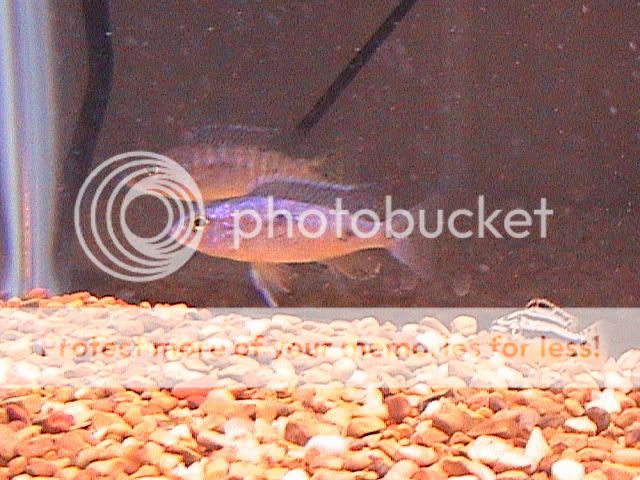
DSC00311.jpg


DSC00308.jpg

Hard to say. The 3 spots on the body are charactaristoc of Otopharynx species. Young O. lithobates can easily be mistaken for S. fryeri as they are similar in shape . O. lithobates x S. fryeri hybrids are not uncommon either so unless you got your S. fryeri from a reputable source it's likely you got a cross.

 
straitjacketstar;771781; said:
Hard to say. The 3 spots on the body are charactaristoc of Otopharynx species. Young O. lithobates can easily be mistaken for S. fryeri as they are similar in shape . O. lithobates x S. fryeri hybrids are not uncommon either so unless you got your S. fryeri from a reputable source it's likely you got a cross.

So what does this mean in common terms...?
 
MonsterFishKeepers.com