From page 4, a comment well worth repeating, from a valued & highly respected past member of MFK, Chris, aka cchhcc.
No real need for anything other than the NLS. Some good fishkeepers still like to vary the diet a bit, but I don't do much of that anymore.
Of the items you listed, there's no need for more than one prepared food (i.e. spirulina flakes and NLS). Also, the bloodworms aren't a great item for more than once in a blue moon.
In the wild, most Amphilophus are primarily invertebrate feeders. They graze in the substrate, taking in lots of edible and inedible material, in an effort to sort out the crustaceans, snails, tiny organisms, etc. There is a fair amount of plant matter being consumed, even if plants aren't their chief target.
In captivity, there is little need to complicate diet matters as was once required. Years ago, pellets were adequate at best, but now some have become very complete diets with a solid nutritional profile. Certainly some are better than others, but the premium brands are great staple foods. You'll find the great majority of breeders and collectors feeding a primarily pellet based diet.
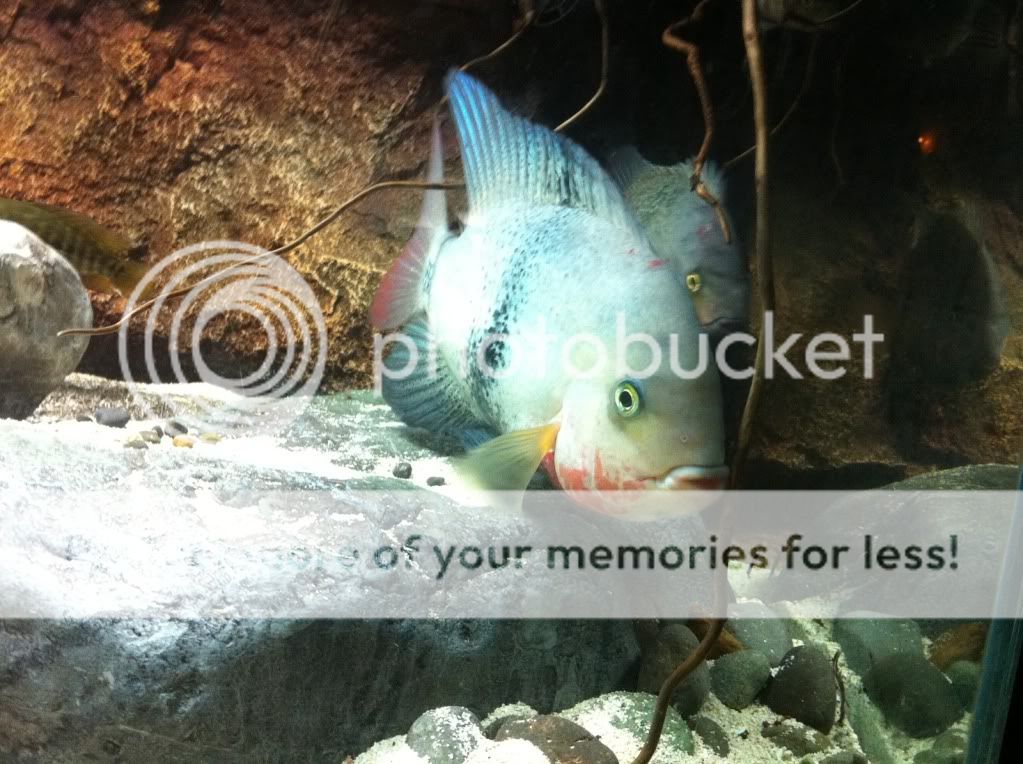
One thing I believe is overlooked a lot is pellet size. Most fishkeepers tend to feed the largest pellet their fish can take, but I don't think that's always wise. Piscivores certainly seem to do well with that approach as they are built for taking in large food items. Many Amphilophus, though, are quite different. The grazing species like robertsoni, rostratus, altifrons, etc. spend most of the day sifting through the substrate straining out tiny bits of food. The more familiar types (citrinellus, labiatus, etc.) are more like "pickers" in eyeballing interesting items first, and then nibbling on them. Lyonsi would fit more in that second category. Regardless, I think most Amphilophus would do well given the opportunity to graze on tiny sinking bits (like small 1 mm pellets) several times a day. The bigger species or non-sifting types (like your lyonsi) could also be offered larger options (floating or sinking) from time to time too.
And on that note ....
I acquired a 4" FH straight from Taiwan from a friend of mine.. so I went out and bought the NLS with the FH on the cover. He ate it, and he looked nice.. It however clogged up my AC110's like nobody's business.
A perfect example of what happens when using a pellet too large for a fish.
A 4" FH can't swallow a 3mm pellet whole, so they chew & expel fine particles via their mouth & gills, hence the reason for your filters were getting clogged up. A waste of food, and a waste of money, with probably close to half of what you were feeding ending up in your filters. A classic example of operator error.
I have 3 tanks with FH ranging from 6" to 11", all 3 tanks are filtered by AC 110's, and all 3 tanks are fed NLS exclusively. I clean my AC 110's once every 3-4 months, even though the flow rate is still close to max output. Never once have I had a filter clog up on me, from
any brand of food.
With regards to feeding a variety ........
Almost any decent food on today's market will give you pretty good results with
freshwater fish. But try feeding some of these foods
long term to some of the more nutrient sensitive marine species, such as Rock Beauty, Moorish Idol and Achilles Tang. Most commercial foods won't even keep them alive, let alone thriving. This is exactly the reason that marine people tend to feed a 'wide variety' of food to their fish, because in the past, if they didn't, their prized specimens would waste away within a few months. Freshwater fish keepers followed the same path, sort of a hit & miss type of feeding in the hopes that all of the fishes dietary requirements are being met. What's lacking in one formula, will hopefully be found in the next container on the shelf.
Feeding a random collection of fish foods does not equate to supplying any more "variety" in nutrients than feeding one food that already consists of a
wide variety of high quality raw ingredients. Variety is not a nutrient.
It is with these types of fish mentioned above that NLS becomes
superior at an unrivaled level. No other commercial food will give you the same type of results as NLS, none. Try feeding fish such as the one shown below (which was raised on NLS) Hikari Gold, Or Omega, or Xtreme, or whatever, exclusively, and get back to me in a few months.
Kieron Dodds, from Tropical Fish Hobbyist magazine wrote an article on the Moorish Idol in 2008, titled; "Still Impossible After All These Years - Keeping Moorish Idol". He clearly admits that the main intent of his article was to discourage anyone from acquiring this species, as he feels this species has almost no chance in being kept alive in captivity beyond a very short duration. At one point in the article he states
"Pablo Tepoot is perhaps the single individual who has had the most success with this species" - unfortunately Pablo lost his last group of Moorish Idol to an electrical failure during a hurricane, at that point Pablo had kept them thriving in captivity for
5 years.
Something that most people would have considered impossible 15 or 20 yrs ago.
Even today, many marine keepers will highly discourage the collection or keeping of this species due to its poor survival rate once in captivity. Yet today, those that have got these & many other nutrient sensitive species of marine fish eating NLS have found that these fish are almost easy to keep, even for beginners. The Moorish Idol shown above was from a beginners marine tank, this was his very first SW tank!
The true acid test of any fish food is with some of these hyper nutrient sensitive marine species, not with fresh water fish.
Show me another manufacturer that has maintained some of the nutrient delicate marine species that Pablo Tepoot has, for many years, on an exclusive diet of their commercial dry pellet or flake formula. You won't find any, quite honestly I believe that you would be very hard pressed to find
any seasoned marine keepers that even feed brands such as Hikari, to their fish. Why is that?
If you keep marine fish, especially some of the more difficult to keep in captivity species, this is where foods begin to play a much larger role beyond just color, and/or growth. You can't simply jack up a low grade food with astaxathin, marigold meal, and spirulina, and expect that it will keep that fish thriving in captivity. It's not that simple, and with the more difficult species you best provide them with the best of the best raw ingredients, or you can kiss that $200-$300 fish good-bye.
With many marine species, it's a matter of life & death.
Unlike most freshwater species, you simply can't keep species such as Moorish Idolor even Cleaner Wrasse on a mediocre starch laced food & keep them alive, let alone thriving, let alone colorful. Most cleaner wrasse in captivity die within weeks, at best they survive a few months, yet many marine keepers have found that if their cleaner wrasse will eat NLS, they will live for
years in captivity. Again, I don't know of any other commercial food on the market that has produced these types of results. None. Most of these species will die in captivity even when fed a "wide variety" of pellets, flakes, and fresh/frozen.
This is precisely why a commercial hatchery such as ORA feeds NLS to their captive bred marine fish, including their mandarin gobies. For anyone that has ever kept mandarin gobies in captivity you will understand how difficult this genus can be to get on to a pellet food, and then keep healthy long term.
As previously posted in another recent discussion, NLS is also the only food that I'm aware of that has been used in studies performed by 3rd party accredited institutions as the control diet in HLLE/HITH studies, due to it's nutrient levels exceeding most/all other commercial products on the market. NLS is the food that the nutritional experts use as their control diet, when studying various nutrient induced health issues in finfish. There's a reason for that.
For myself I look for the best of both worlds, a food that will keep even the most difficult to keep species in captivity thriving in a glass cage, as well as provide great color, growth, and breeding. As I recently told Tom (Aquanero) via PM, as nice as his RD looks on an exclusive diet of NLS, I suspect that he could feed that fish rabbit pellets & it would still look very nice. Ditto to Balton's female festae, and most of Mo's fish. Those fish look great because they are genetically great specimens, and have been well taken care of by experienced fish keepers, not because some brand of food made them into show quality fish.
To a large extent this hobby is very much about visual impact and most hobbyists want to see eye popping color, and for some hobbyists that's
all they care about.
Personally I want to see color that matches the best looking specimens found in the wild, good solid growth, and breeding, but at the same time I want to provide the most nutritionally sound diet that I can offer my fish in the hopes that they reach their maximum potential health wise as well. If I can get 10 yrs out of a fish, vs 7 yrs, that too is important to me. If I can keep a fish healthy even when under the stress of captivity, aggression from rival tank mates, the introduction of various pathogens, or improve the rate of healing when injured, for myself that's just as important as great color. A carefully selected number of b
ioactive compounds, at levels that have been proven to have a probiotic effect on fish including biological effects such as growth promotion, immunostimulation, anti-stress, anti-bacterial, anti-fungal, and anti-viral are some of the key reasons for the success of NLS.
Sometimes it's the little things that separate a good food, from a GREAT food, and yes, even a
superior food.



 while we are on the topic, I feed exclusivly NLS at my house (minus a picky massivore crackhead aka male dovii). 90% of my fish take anything but I like the overall results I've seen with NLS so I guess you could call me a loyal follower as well.