


I feed my Black Aro and T Gar pinkies every once in a while. I try to vary the diet as much as possible, I think that's key. Pinkies are cheaper in quantity and you can get them frozen so they are very easy to feed on a regular basis.
Feeding fish mice?
- Thread starter daddyjohn86
- Start date
You are using an out of date browser. It may not display this or other websites correctly.
You should upgrade or use an alternative browser.
You should upgrade or use an alternative browser.

daddyjohn86;4581054; said:Ok, i know its a risk what do you recomend on how long i should quarantine before feeding them to my rbps? And what would be a different fish that would be resonably priced it seems like the only option from the local pet stores, and i just love to watch them chase the fish around.
O and i forgot to mention i also feed them the live big night crawlers for bait, bought at walmart, its just not as cool as goldfish..
Really? you enjoy goldfish more then night crawlers? i personally enjoy the show more with night crawlers then feeder fish. Convicts would most likely be the cheapest option but most people have to breed them themselves if there isn't a local breeder or a fish store that's constantly supplied with them. marble craw is also becoming a popular option for home breeding.
let me me go find a sticky for you, if any of those fish aren't available for cheap and you dont' want to go through the hassle of breeding them yourself, then i'd just drop the goldfish from the diet then. you can easily buy fillete fish from your supermarket to feed them instead. just chop it up into decent size pieces and toss in the tank.
link and info from the link below it
http://www.monsterfishkeepers.com/forums/showthread.php?p=3871623#post3871623
http://www.monsterfishkeepers.com/forums/showthread.php?p=3871623#post3871623
Diogenes;3871623; said:Piranha nutrition seems to be a revolving topic here, so I'm going to create an "end all" piranha nutrition thread. Let's make this a good thread and maybe we can get a sticky.
If anybody has any other advice, info, complaints, or tips, please share them below. Thanks, -C.
In the wild
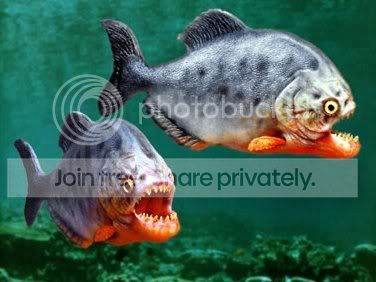
Piranhas in the wild primarily obtain food by foraging, ambushing, and scavenging. The feeding behavior appears to vary according to the size and maturity of the fish, with smaller fish (80-110mm TL) usually foraging for food during the middle of the day. Slightly larger fish (150-240mm TL) typically venture forth to forage at dawn, late afternoon, and the early evening.
Juvenile to adult size fish typically ambush their prey. They live in shoals and spend much of their time lying quietly in wait amidst areas of heavy vegetation. When a suitable food source encounters the piranha shoal, the entire group will participate in the ambush and subsequent feeding.
Piranhas are also typically referred to as the Amazon's "clean-up crew" because of their propensity for scavenging the remains of nearly anything that dies in the Amazon, especially during the dry season. This behavior is largely responsible for the myth that piranhas commonly eat avian and mammalian meat. While they are opportunistic enough not to let any sort of meat go to waste, especially during the annual dry part of the rain cycle, these foods are not a major part of the piranha diet.
So what do piranhas eat in the wild? The diet of piranhas are typical of many freshwater fishes, they eat fish, snails, insects, crustaceans, and some plant matter. These food items form the bulk of their diet, and should be the basis for their diet when kept in aquaria as well.
Fins and scales form a common food type for nearly all members of the family Serrasalminae. Piranha fins grow rapidly and their social nature ensures that there is always a steady supply of fins and scales nearby to dine upon. Indeed many members of the genus Serrasalmus eat a diet largely consisting of fins and scales. Fin and scale nipping is, in a way, piranha niche feeding, and this behavior is why many piranha enthusiasts recommend keeping piranhas in a species only setup.
The preferred fish type eaten by piranhas is largely a mystery, however most scientific evidence seems to point towards perciform fish of the family Cichlidae (sorry cichlids). Many piranha keepers who insist on feeding live foods will often keep a colony of breeding cichlids for this purpose, although it should be noted that feeding live food is never a necessary part of keeping piranhas.
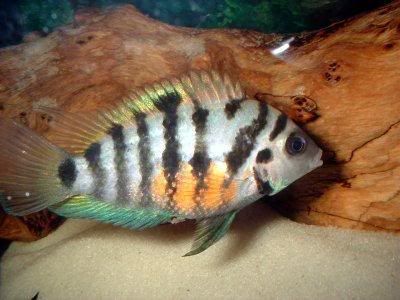
easily bred, the ubiquitous convict cichlid from central america is a favorite piranha feeder
In the Aquarium
There are many misconceptions regarding the diet of piranhas kept in aquaria. Many LFS employee don't know much about the proper care of piranhas. I have personally heard LFS employees advise people purchasing piranhas to feed them chicken wing bones, mice, goldfish and rosy red minnows. This is NOT the correct diet for piranhas. We'll discuss some of the reasons why these are bad choices for your piranha later.
What should you feed your piranha? Well the easiest, cheapest, and most staple foods can be found at your local grocery store. Raw market shrimp, and frozen fish filet are cheap and healthy food choices for your piranha. The debate continues to rage among piranha hobbyists concerning whether or not the shell should be removed from shrimp before or after feeding to your piranha. Advocates of "shell on" say that it's a whole food, and that color enhancing compounds are contained within the shell. Those who remove the shell often argue that it's easier to keep the tank clean, and thus ensure pristine water quality for your fish. Both are legitimate arguments. Fish fillet should be white fleshed, such as tilapia, or catfish. Often these fish fillets can be found in the seafood section of the grocery store for a couple bucks for 2 good sized fillets. Try to avoid feeding greasy fish like salmon, as this has been shown to negatively affect water quality. Make sure that you remove any uneaten food as soon as possible so as not to foul the water.
The best preparation for these frozen foods that I've personally heard is relatively simple. Purchase your shrimp or fish fillets, unthaw a couple weeks worth of food, dice into pellet sized chunks, soak in a vitamin supplement such as Kent Zoe for 30 minutes, and re-freeze. To feed, simply unthaw the chunks and feed them to your fish. It's a simple parasite free way to ensure that your fish are getting all the nutrition that they're being starved of when fed the unsuitable diet normally recommended by people unfamiliar with keeping piranhas.
Pellets are even better. The problem with pellets is that many hobbyists encounter problems getting their fish onto pellets. However, with a little patience even the most stubborn wild caught fish can be weened onto pellets. Pellets offer the most balanced nutrition, and piranhas kept on a steady diet of pellets often show the best colors, and grow the fastest. If you encounter problems getting your fish to eat pellets, try soaking them in a garlic solution to entice the fish into eating them at first, or you can try and mix pellets and shrimp/fish chunks together in a 50/50 mixture. The smell of the shrimp/fish will soak into the pellets making them more desirable to your fish.
If you decide that you want to feed live fish to your piranhas, it should be considered a treat at best. Think of live fish as a deep fried twinkie for your fish. They may enjoy it, and they will certainly enjoy the thrill of the hunt, but feeding live can have negative consequences for your fish. Parasites are a major problem with feeding live fish, and as a result it is recommended that all feeders fed to piranhas be bred at home by you. Convict cichlids, mollies, guppies, angel fish, tetras, and freshwater river shrimp (glass, and cherry shrimp et cetera) are all good candidates for home feeder fish. NEVER FEED YOUR FISH GOLDFISH or other members of the family Cyprinidae!

deep fried twinkie. mmmmm corony bypass with sugar on top...
Cyprinidae, Goldfish, and Thiaminase
Thiaminase (There are 2 types, Type I & Type II) is an enzyme.
Enzymes are biological catalysts made of proteins.
A catalyst is a substance that speeds up a chemical reaction without being consumed by that reaction. It makes reactions happen faster. Like if a log rots over 5 years, and you somehow catalyze all the chemical reactions involved & make it rot in 5 minutes.
Our bodies require enzymes to speed some of the chemical reactions required in our metabolism.
Thiaminase destroys Thiamine (Vitamin B1). Rendering it into two molecular parts.
Regular intake of substantial amounts of food containing thiaminase could introduce enough thiaminase into the gut to break down the thiamine in food & render an animal thiamine-deficient.
Some fish contain thiaminase (Type I, not II) and some do not.
Fish that contain Thiaminase:
All members if the family Cyprinidae
White Bass – Morone chrysops
Bowfin – Amia calva
Bream – Abramis brama (Not the U.S. fish; see this link).
Buffalofish – Ictiobus cyprinellus
Bullhead catfish – Ameiurus m. melas
Carp – Cyprinus carpio
Channel Catfish – Ictalurus punctatus
Fathead minnow – Pimephales promelas (the red rosy is a color morph of this fish!)
Garfish (Garpike)
Goldfish – Carassius auratus
Moray Eel – Gymnothorax ocellatus (since someone recently asked about keeping the brackish water species with turtles…
Gizzard Shad – Dorosoma cepedianum
Spottail Shiner – Notropis hudsonius
Buckeye shiner – Notropis atherinoides
Central Stoneroller – Campostoma anomalum pullum
Common White Sucker – Catostomus commersoni
Lake Whitefish – Coregonus clupeiformis
As we've already discussed, thiaminase destroys vitamin B1, but what does B1 do? Well according to the university of Maryland medical center B1 has a profound effect on the health of nearly all animals, including humans. The article below describes B1 in relation to its effects on humans, but keep in mind that B1 plays a similiar role in the life of your fish:
Vitamin B1, also called thiamine or thiamin, is one of 8 B vitamins. All B vitamins help the body convert food (carbohydrates) into fuel (glucose), which is "burned" to produce energy. These B vitamins, often referred to as B complex vitamins, also help the body metabolize fats and protein. B complex vitamins are necessary for healthy skin, hair, eyes, and liver. They also help the nervous system function properly, and are necessary for optimal brain function.
All B vitamins are water-soluble, meaning that the body does not store them.
Like other B complex vitamins, thiamine is considered an "anti-stress" vitamin because it may strengthen the immune system and improve the body's ability to withstand stressful conditions. It is named B1 because it was the first B vitamin discovered.
Thiamine is found in both plants and animals and plays a crucial role in certain metabolic reactions. For example, it is required for the body to form adenosine triphosphate (ATP), which every cell of the body uses for energy.
Thiamine deficiency is rare, but can occur in people who get most of their calories from sugar or alcohol. People who are deficient in thiamine may experience fatigue, irritability, depression and abdominal discomfort. People with thiamine deficiency also have difficulty digesting carbohydrates. As a result, a substance called pyruvic acid builds up in their bloodstream, causing a loss of mental alertness, difficulty breathing, and heart damage (a disease known as beriberi).

In humans, Thiamine deficiency can cause the disease known as beri beri.
As you can see, there are many healthy foods available to feed your piranhas. By making healthy choices concerning your piranhas diet you can ensure big, pretty, toothy predators will thrive in your tank for a long time. Your friends will be much more impressed with brightly colored, beefy, foot long RBP's, being raised on pellets, than they will with thin, emaciated, stunted, parasite ridden piranhas that are too sick to go after their goldfish dinner. Keep that in mind the next time you buy dinner for the shoal.

References:
http://www.umm.edu/altmed/articles/vitamin-b1-000333.htm
www.OPEFE.com
www.piranha-fury.com
http://www.austinsturtlepage.com/Articles/Thiaminase.htm


Good post ballin.
Any way you slice it a pellet diet is much healthier for any type of fish than live foods. Much more rich in vitamins and no nasty tag along parasites.
Call me a Hippie, But im also not one to watch an animal suffer for my own enjoyment. I think respect and appreciation for all living critters, ecpecially the ones that rely on you for happiness and health, is one the greatest things this hobby has taught me.
Any way you slice it a pellet diet is much healthier for any type of fish than live foods. Much more rich in vitamins and no nasty tag along parasites.
Call me a Hippie, But im also not one to watch an animal suffer for my own enjoyment. I think respect and appreciation for all living critters, ecpecially the ones that rely on you for happiness and health, is one the greatest things this hobby has taught me.
flowerpower;4581358; said:I didn't realize that you bred the mice for your snakes. Otherwise, 2-3 live pinkies per night would be insanely expensive. How many do you breed to have enough mice for your snakes and your rbp's? That's gotta be a lot of mice!
I'm no expert on piranha but, like with any animal in captivity, I'd do my best to figure out what their diet in the wild consists of and base what I feed on that. If rodent meat tops the menu then your golden. Otherwise I'd limit the amount of mice and feed something else that is more suitable. It also may be worth figuring out how they feed. Do the hunt and strike live prey or are they opportunistic feeders who scavenge on newly dead carcasses? Feeding freshly killed mice (or rats, which have more nutritional value than mice) rather than live ones may be more natural for your fish (it's definitely more humane for the mouse).
You could also check the piranha section and read the stickies. There's probably loads of info there.
I actually dont have any snakes i breed the mice just for my piranhas. Yes it is allitle on the expensive side for start up but if you want to feed pinkies to your pet its not that bad. The local pet stores sell each pinkie dead and frozen and only 2 days old ( very small) for 2.00 each plus tax. that comes out to 33.00 aprox after tax for 15.00 ..
I bought two of the all in one mice set ups at petsmart ( each comes with: cage, food dish, water bottle thing, and food and bedding for 6 months) on sale for 15.00 each, the boy mouse was 6 bucks and each female was 2 bucks.. bringing my total investment too a whoping 40.00
had these for a month and had 12 pups from one and 14 pups ( after three weeks they gave birth and there already both prego again) from the other brining babys totals too 26 pinkys in three weeks, 26 pinkys in the store would have been 52.00 before tax so with three weeks ive already recooped my losses and they are the easiest pet ive had to take care of.
Well, how is this for a good reason. Your predatory fish are primarily piscivores. That means they are designed to ingest and process fish and at different ages, invertebrates and crustaceans. Maybe even the odd amphibian. In essence, the kinds of things swimming with them. Mammals have a different body composition. If you choose to continue feeding mammalian proteins and fats to your piscivorous fish, expect them to die young from fatty liver disease. It is really as simple as that. The only "fish" designed to take mammalian prey are marine and they have been designed to scavenge on dead whales and take pinnepeds and porpoises.
As "cool" as you might think it is to feed mice to your fish, all you are proving is that you are too immature to separate what is good for a cheap thrill and what is good for the animal in your care.
As "cool" as you might think it is to feed mice to your fish, all you are proving is that you are too immature to separate what is good for a cheap thrill and what is good for the animal in your care.

While I don't know much about piranhas, LRM is spot on regarding feeding something the fish is not designed to eat.
There will be health consequences for anything fed what it is not supposed to eat. Both short term and long term.
Take the cat for example. Felines are designed to eat meat in the form of other animals - birds, mice, baby rabbits etc. Their digestive system is set up to handle high protein, and high fat. When you feed a cat a food that is primarily grain (corn, wheat, oatmeal, rice etc), it puts lots of stress on their bodies as the digestive system attempts to process it. This can lead to diabetes, liver and kidney problems, weight gain, and allergies.
Why would you sacrifice the health of your fish for the couple minutes of 'coolness' that comes with feeding mice?
There will be health consequences for anything fed what it is not supposed to eat. Both short term and long term.
Take the cat for example. Felines are designed to eat meat in the form of other animals - birds, mice, baby rabbits etc. Their digestive system is set up to handle high protein, and high fat. When you feed a cat a food that is primarily grain (corn, wheat, oatmeal, rice etc), it puts lots of stress on their bodies as the digestive system attempts to process it. This can lead to diabetes, liver and kidney problems, weight gain, and allergies.
Why would you sacrifice the health of your fish for the couple minutes of 'coolness' that comes with feeding mice?

DaddyJohn86, your abundance of mice would make any rodent eating reptile very happy. The mice would be a staple for the herps and a treat for the piranhas (when you want to put on a show).
That seems like a good balance to me. I personally keep ball pythons and I too feed live.
That seems like a good balance to me. I personally keep ball pythons and I too feed live.
