

Help me build my 540 gallon
- Thread starter gavigan1
- Start date
You are using an out of date browser. It may not display this or other websites correctly.
You should upgrade or use an alternative browser.
You should upgrade or use an alternative browser.


Why do you have the intake pipe going up the overflow box? You could let the water run down the sides of the overflow box and exit the box at the bottom of the box like this:

You could also plumb a return line from the sump through the overflow box. Like this (sorry, I'm not good with paint)

The return line from our mechanical filtration comes up and through the overflow box, turns and enters the tank through the hole on the right. We can turn the return nozzle in different directions.
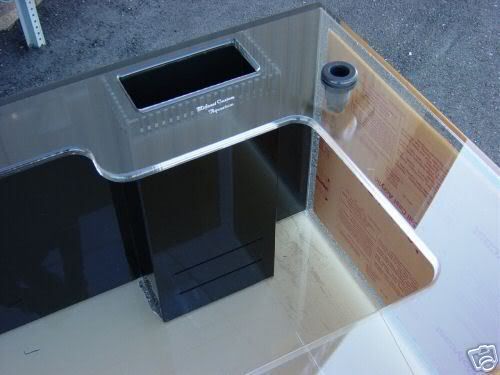
We've got quite a current with the Hammerhead pump. The current bounces off the far wall and heads back in the other direction, forming an eddy in the middle of the tank. You can see the current we have. This old video was taken during a water change. Our fish love the swift current.
[YT]7v2Vyr5NbNs[/YT]
You could also plumb a return line from the sump through the overflow box. Like this (sorry, I'm not good with paint)
The return line from our mechanical filtration comes up and through the overflow box, turns and enters the tank through the hole on the right. We can turn the return nozzle in different directions.
We've got quite a current with the Hammerhead pump. The current bounces off the far wall and heads back in the other direction, forming an eddy in the middle of the tank. You can see the current we have. This old video was taken during a water change. Our fish love the swift current.
[YT]7v2Vyr5NbNs[/YT]
Thanks for the feedback. In my current tank I feel like some of the suspended debri does not move up the water column to the skimmer. I was thinking that if I returned the water from the bottom it would push debri up the water column but I would wind up with 3 water fountains and defenitiely dont want a flood? I like your drawing of adding another return at the top, I think I will do that . I would like to hear more thoughts on this design.
I wont have room for returns in the overflow box. I am planning 2 x 1.5in intakes with a 1in intake to set water height in overflow box/at as emergenct drain ( based on the bean animal design for quiet operation). These will empty into two 8x16 100 micron filter socks into sump. Im not that good with MS paint so I could not label and it wont let me upload in a word document? (If anyone knows how to a document let me know)
This may help with the drawing:
Red ovals = valves
Grey triangle = check valve
Green= bio balls
beige area in sump= filter sock
I wont have room for returns in the overflow box. I am planning 2 x 1.5in intakes with a 1in intake to set water height in overflow box/at as emergenct drain ( based on the bean animal design for quiet operation). These will empty into two 8x16 100 micron filter socks into sump. Im not that good with MS paint so I could not label and it wont let me upload in a word document? (If anyone knows how to a document let me know)
This may help with the drawing:
Red ovals = valves
Grey triangle = check valve
Green= bio balls
beige area in sump= filter sock
Your drawing was excellent. No need to label anything. Are you planning to submerge your bioballs? If so, perhaps a ceramic media might be better...
Also, the only time there is noise in our overflow box is when debris clogs the prefilter sponge at the intake opening, and the water pools down there. Otherwise, it's silent.
We shove a prefilter sponge in the uptake bulkhead.

Food and debris sometimes manage to make it through the slots of overflow box, which this prefilter sponge traps.
Also, the only time there is noise in our overflow box is when debris clogs the prefilter sponge at the intake opening, and the water pools down there. Otherwise, it's silent.
We shove a prefilter sponge in the uptake bulkhead.
Food and debris sometimes manage to make it through the slots of overflow box, which this prefilter sponge traps.
I have read all these posts about overflows being so noisy. I wonder if your overflows are quiet because of the hammer heads gph keeps the water level well above the height of the bulk heads in your overflow. That would be great!
My plan for sump will have the water from the filter socks movinging over the drip plate , trickle through the bio balls( they will not be submerged)
All of this depends on if I get this home made 144x18x30H home made acrylic tank which I plan to cut in half, cut down the height and use the scrap to make dividers. Other wise I will have to go with some sort of rubbermaid tub or tote.

My plan for sump will have the water from the filter socks movinging over the drip plate , trickle through the bio balls( they will not be submerged)
All of this depends on if I get this home made 144x18x30H home made acrylic tank which I plan to cut in half, cut down the height and use the scrap to make dividers. Other wise I will have to go with some sort of rubbermaid tub or tote.
I picked up some used stuff of of Craigs List:
3 Red Sea Ocean Clear Canisters, 200 plus lbs of tahitian moon sand, and a Danner pondmaster hy-drive 3000 gph pump.
I may have to re think some of the plumbing and returns? I havenet drilled any additional holes or ordered bulk heads yet.....

3 Red Sea Ocean Clear Canisters, 200 plus lbs of tahitian moon sand, and a Danner pondmaster hy-drive 3000 gph pump.
I may have to re think some of the plumbing and returns? I havenet drilled any additional holes or ordered bulk heads yet.....
I am thinking of putting 2 of these and acrylic lids. I was going to build a wooden canopy w T8s but given the 45in H tank and 30in H stand it will be very tall already.

36" T5 Quad Deluxe 156W Marine Version(4x 39W)
Excellent for marine, reef, and cichlid aquariums.
Extendable brackets - 40" Max Length
Fixture comes with 2x 10000K and 2x Actinic Blue lamps.
Features:
36" T5 Quad Deluxe 156W Marine Version(4x 39W)
Excellent for marine, reef, and cichlid aquariums.
Extendable brackets - 40" Max Length
Fixture comes with 2x 10000K and 2x Actinic Blue lamps.
Features:
- Dimensions - 35.50 x 7.50 x 2.15
- Brackets add 0.50" in height
- Supports 4x 39W T5 High Output lamps
- Supports 4x Bluemoon LED
- Supports standard T5 HO lamps
- 156W total power
- Quick disconnect ballast
- Individual power cords for each function
- Extendable bracket - 40" max extend
- Non-corrosive powder coated aluminum housing
- Reflector
- Acrylic splash guard
- CE Certified
- 1x 36" T5 Quad fixture
- 2x 39W T5 HO lamps 10000K (Free Item*)
- 2x 39W T5 HO lamps Actinic Blue (Free Item*)
- 4x LED (Free Item*)
Hi Mike. As requested, I've subscribed to the thread. I won't be able to dedicate a lot of personal time to the build. Math-wise, I have some threads in the sticky sections that will guide you through plumbing sizing, etc.gavigan1;4752506; said:...There does not seem to be any seperation between the panels. If the discoloration was separation between the panels secondary to stress - I would think that it would start at the inner wall and move outward...
Weldon 4 is the right plan. Unfortunately, you are mostly right about not having (appreciable) separation between the panels. Getting the Weldon 4 to draw into the damaged area is going to be hit and miss. The bond is broken in that area but unfortunately the gap is only molecules thick.
If the first attempt at repair doesn't work, you can drill inward along the seam with a drill bit the size of the injection needle. You will need to fill these later.
Plastics, along with acrylic, are polycrystalline materials and can absorb water at interstitial molecular locations. Acrylic is notorious for its absorption and its inherent problem; it curves in the direction of highest water concentration. In the case of tanks, it bows inward. This is countered by the water pressure pressing outward. When the tank is drained the outward pressure is no longer present, so the only force is that curvature pressing inward. That is why the seams in acrylic tanks are frequently damaged from the outer corner rather than the inner. Two members here local to me (robkob & milkman) both had acrylic tanks that had bad seams and both were audible (crackling) when they were drained. Robkob's seam became significantly worse during the drain down.
With that said, I don't want to scare you about the tank; However, be cautious with it. Used acrylic tanks, unfortunately, should only be garage or basement tanks (if the basement has a sump or floor drain). You can use it for an indoor tank but be wise about its placement. Don't use it where it could be financially devastating.

pacu mom;4755328; said:Why do you have the intake pipe going up the overflow box? You could let the water run down the sides of the overflow box and exit the box at the bottom of the box like this:
That is a very, very bad idea. That would make his tank sound like Niagra falls with all that water crashing. Definitely run a Durso, or better yet, a Herbie pipe like Clay suggested. I have a Herbie pipe on my tank and it is DEAD SILENT. Dursos are good since they reduce the noise of the water crashing into the overflow box, but they do nothing to address the noise of the water gurgling in the drain line. A Herbie pipe address the overflow noise, and the pipe gurgling.
As for the buffer, those random orbit buffers are no good. You need a high speed direct drive buffer to really polish the scrathes out. A random orbit buffer is just a big vibrator with a pad really (ha!).
That is all I have for now

