New Channa Gachua growout (Picture heavy)

  • We are currently upgrading MFK. thanks! -neo
thanks, It's one of those setups that evolves week to week , doesn't take long for the leave to skin then start to break down, that plant also grows incredibly quickly.

Here's the tank now, most of the leaves have settled in, I don't want to ad to many more so i added some mini water lettuce, GREAT plant for channa keepers.

DSC08612_zps9574352e.jpg


from above

DSC08616_zpsae092870.jpg
 
Another update, I believe I have my first pair starting to form.

Not long ago one of them started to become quite dominate in the tank and has grown significantly larger then the others, I suspect she's female and as she started driving others into hiding. A few exceptions seemed to be left alone to swim near the surface as long as they staid out of the largest ones way.

For the last couple days another has started to catch up in growth and i suspect it's a male. He also stays much closer to the larger suspected female, he flares at the others in the tank if they swim out, but never at the larger female, she also doesn't chase him off into hiding while all others are being chased away to live hidden in the leaves. They are still very small and young but if they keep it up I'll likely pull them out into a new tank of their own and see if my suspicions are correct!

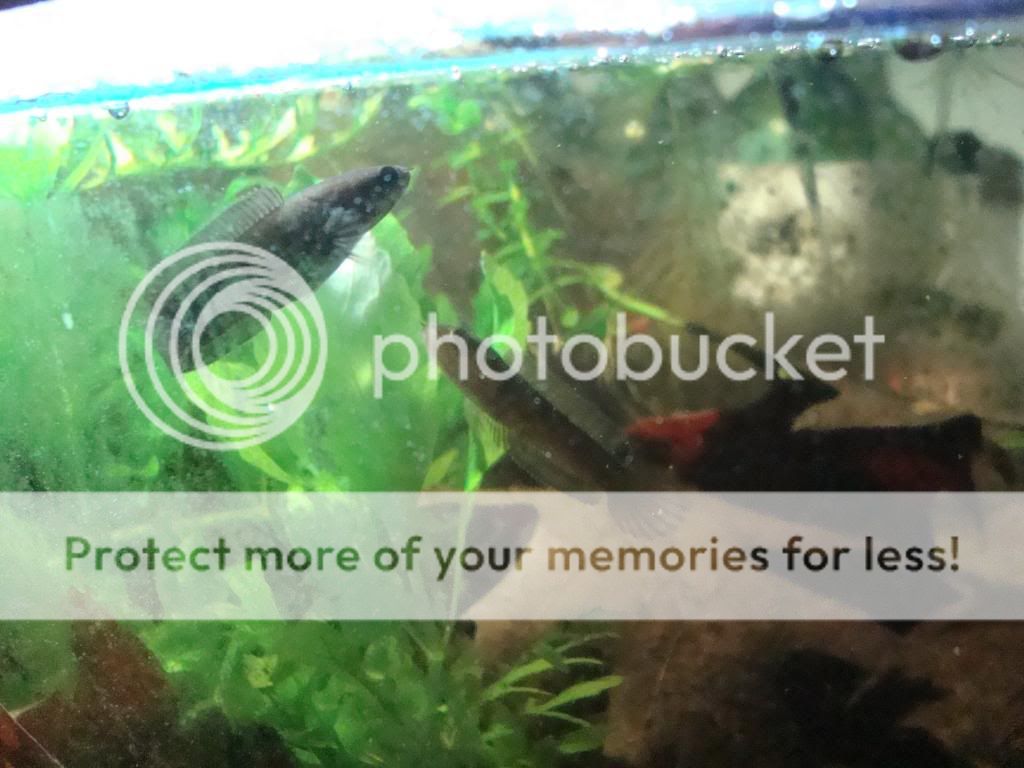
Any way here are the pic's , The tank's glass is very dirty, covered in algae but I don't want to disturb them just to clean the glass. I did my best to take the pic's through the clearest spots lol!

First here are the 2 I suspect are pairing up,My guess is female on the top/left, male on the bottom/right.

DSC08845_zpsdf28bf63.jpg


suspected female from the pair above...

DSC08846_zps4216880e.jpg


DSC08847_zps2167a49f.jpg


Suspected male from the above pair, harder to get a nice shot of him he's much more shy and skittish stays away from me when i look/take pic's unless I'm feeding them.


DSC08861_zps8de634d9.jpg
 
Greetings, Devon!
Congratulations for the possible couple!
Sorry for the ignorance, but the eyespot on the dorsal fin of the alleged male is a signal of sexual dimorphism or not?
Bye!

good question, I have been wondering the same thing. It's not a sign of dimorphism that I've read about any where and almost all of them have some sort of dorsal fin spot. But i do find some have much more pronounced clear spots with a ring of orange, while others have very faint spots almost unnoticeable.

Also I am finding of the 10 I have the ones that look male do seem to have the clear pronounced spot with thin ring of orange around it. While the ones that seem "female" seem to have very faint spots sometimes only noticeable from a certain angle. I don't know for sure that my guesses on gender are correct though until they mature some more, and I'm also hoping to find more people who have breed the species or at least who have document grow outs of pairs to see if my observations are a trait or just a coincidence.
 
Thanx!
Good luck on your experiences and what else we aggregate information about sexing ... Unfortunately, my attempt to form a pair of this species was not successful ... Maybe one day I can and use their expertise to identify them. I'll be watching.
Bye!
 
Well if it helps, My interests/ research /experience has been focused around sub tropical species from india, what I often see called the gachua/stewartii/aurantimaculata complex.

With them I find the the differences in head/body and fin shape between genders is the best indicator to use and remains pretty similar across the various species. Where males have more arched dorsal fin and narrow body with an "arrow shaped" skull, fins and tail are often longer but its more of a shape difference then length. Females tend to be larger with a rounder bulkier build, straight/shorter dorsal fin and a rounder skull.

There are color and pattern differences between male and females as well, but the differences in color/pattern vary quite a bit between species and between localities and also change with age, I find it causes more confusion and second guessing to try and go by color or pattern.

Behavior wise I have found males tend to be timid often hiding more skittish when I'm looking a them in the tank while females are more bold always looking out from hiding holes, often sitting in open water or in the floating cover not skittish at all more curious, come right to you and stares back when you approach the tank.

I've also noticed females "posture" when flaring tends to be different. Males take a more vertical stance, body curved tail often pointing downward while face looks straight with flared gills. And again females are more bold, I've only seen males flare at other males or at their mate during breeding season. While my females will come front and center and flare at me/puff up their gills try to scare me off if they don't feel like being looked at through the glass, I've seen females flare at my cats through the lass as well lol.
 
What a lesson!
You should not be remembered, but you helped me to identify my Channa gachua (I thought it was a stewartii:duh:) and then advised me too when I tried to form a pair of adults who, in the end, did not work out. If not for your tips probably one of the fish died.
Thank you again my friend:thumbsup:.
 
I remembered, I'm always willing to help if i can.
 
wow thats awesome dc! !!!! what si ze is the tank? ? have nine in a 120 rt now in a tank beside the boys lol

Sent from my SGH-I747M using MonsterAquariaNetwork App
 
lol 120G is HUGE for them but nothing wrong with that!

Mine ar still small, they are in a 15g, Once I'm sure it's pairing I'm seeing I'm going to separate them along with 3 others into another 15g leaving the 5 smallest ones grow a bit probably form another pair.

Then I'll split both tanks again when fights break out. At that point the 2 pairs I'm keeping will each get a 35g of their own to grow out in the rest will be sold.

I wanted to keep space limited to force them to interact and pair up, i compensate with a pile of hiding available in that leaf litter to avoid deaths.
 
MonsterFishKeepers.com