Terrier Group
©Copyright 1978, United Kennel Club, Inc................(1)View Registration Requirements
HISTORY
Sometime during the nineteenth century, dog fanciers in England, Ireland and Scotland began to experiment with crosses between Bulldogs and Terriers, looking for a dog that combined the gameness of the terrier with the strength and athleticism of the Bulldog. The result was a dog that embodied all of the virtues attributed to great warriors: strength, indomitable courage, and gentleness with loved ones. Immigrants brought these bull and terrier crosses to the United States. The American Pit Bull Terriers many talents did not go unnoticed by farmers and ranchers who used their APBTs as catch dogs for semi-wild cattle and hogs, to hunt, to drive livestock, and as family companions. Today, the American Pit Bull Terrier continues to demonstrate its versatility, competing successfully in Obedience, Tracking, Agility and Weight Pulls, as well as Conformation.
The United Kennel Club was the first registry to recognize the American Pit Bull Terrier. UKC founder C. Z. Bennett assigned UKC registration number 1 to his own APBT, Bennetts Ring, in 1898.
GENERAL APPEARANCE
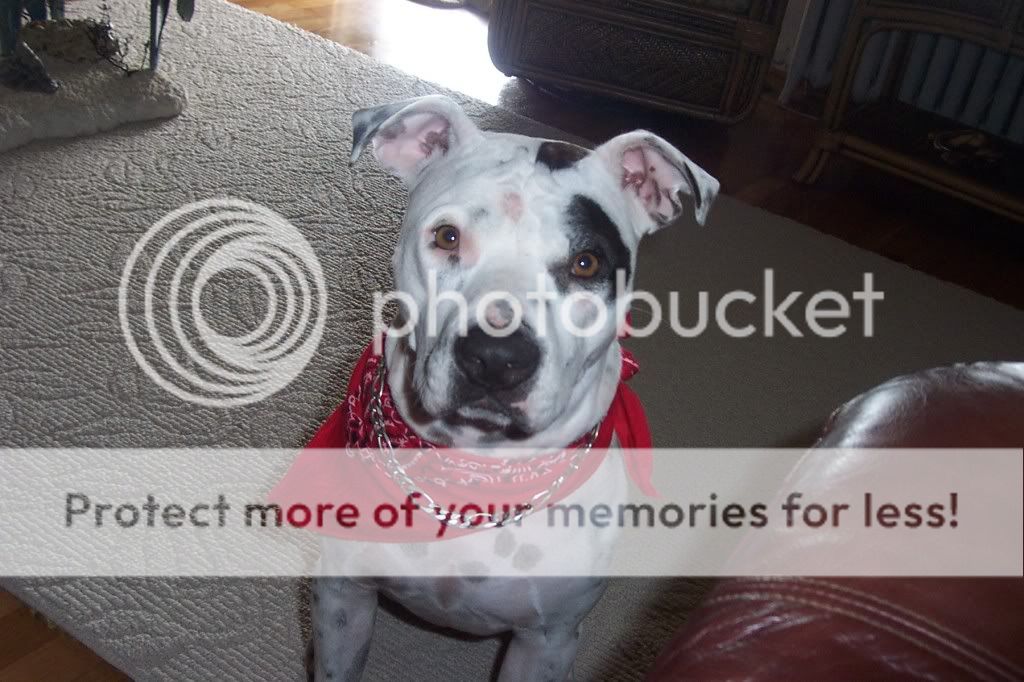
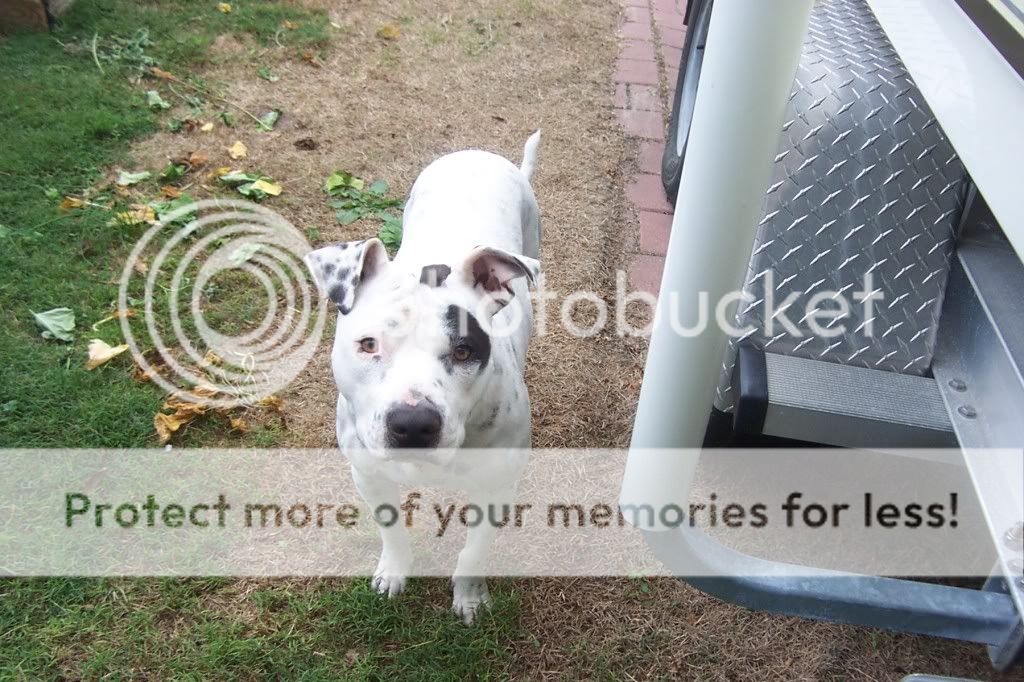
The American Pit Bull Terrier is a medium-sized, solidly built, short-coated dog with smooth, well-defined musculature. This breed is both powerful and athletic. The body is just slightly longer than tall, but *****es may be somewhat longer in body than dogs. The length of the front leg (measured from point of elbow to the ground) is approximately equal to one-half of the dogs height at the withers. The head is of medium length, with a broad, flat skull, and a wide, deep muzzle. Ears are small to medium in size, high set, and may be natural or cropped. The relatively short tail is set low, thick at the base and tapers to a point. The American Pit Bull Terrier comes in all colors and color patterns except merle. This breed combines strength and athleticism with grace and agility and should never appear bulky or muscle-bound or fine-boned and rangy. Above all else, the APBT must have the functional capability to be a catch dog that can hold, wrestle (push and pull) and breathe easily while doing its job. Balance and harmony of all parts are critical components of breed type.
Very Serious Fault: Any disproportionate overdone characteristic (such as short legs, excessive bone or massive head or body) that would interfere with working ability.
CHARACTERISTICS
The essential characteristics of the American Pit Bull Terrier are strength, confidence, and zest for life. This breed is eager to please and brimming over with enthusiasm. APBTs make excellent family companions and have always been noted for their love of children. Because most APBTs exhibit some level of dog aggression and because of its powerful physique, the APBT requires an owner who will carefully socialize and obedience train the dog. The breeds natural agility makes it one of the most capable canine climbers so good fencing is a must for this breed. The APBT is not the best choice for a guard dog since they are extremely friendly, even with strangers. Aggressive behavior toward humans is uncharacteristic of the breed and highly undesirable. This breed does very well in performance events because of its high level of intelligence and its willingness to work.
HEAD
The APBT head is unique and a key element of breed type. It is large and broad, giving the impression of great power, but it is not disproportionate to the size of the body. Viewed from the front, the head is shaped like a broad, blunt wedge. When viewed from the side, the skull and muzzle are parallel to one another and joined by a well defined, moderately deep stop. Supraorbital arches over the eyes are well defined but not pronounced. The head is well chiseled, blending strength, elegance, and character.
Very Serious Fault: Overly large, heavy heads.
SKULL - The skull is large, flat or slightly rounded, deep, and broad between the ears. Viewed from the top, the skull tapers just slightly toward the stop. There is a deep median furrow that diminishes in depth from the stop to the occiput. Cheek muscles are prominent but free of wrinkles. When the dog is concentrating, wrinkles form on the forehead, which give the APBT his unique expression.
MUZZLE - The muzzle is broad and deep with a very slight taper from the stop to the nose, and a slight falling away under the eyes. The length of muzzle is shorter than the length of skull, with a ratio of approximately 2:3. The topline of the muzzle is straight. The lower jaw is well developed, wide and deep. Lips are clean and tight.
Faults: Snipey muzzle; flews; weak lower jaw.
Very Serious Fault: Muzzle too short, which impairs breathing capability.
TEETH - The American Pit Bull Terrier has a complete set of evenly spaced, white teeth meeting in a scissors bite.
Fault: Level bite.
Serious Faults: Undershot, or overshot bite; wry mouth; missing teeth (this does not apply to teeth that have been lost or removed by a veterinarian).
NOSE - The nose is large with wide, open nostrils. The nose may be any color.
EYES - Eyes are medium size, round and set well apart and low on the skull. All colors are equally acceptable except blue, which is a serious fault. Haw should not be visible.
Serious Faults: Bulging eyes; both eyes not matched in color; blue eyes.
EARS - Ears are high set and may be natural or cropped without preference. Prick or flat, wide ears are not desired.
NECK
The neck is of moderate length and muscular. There is a slight arch at the crest. The neck widens gradually from where it joins the skull to where it blends into well laid-back shoulders. The skin on the neck is tight and without dewlap.
Faults: Neck too thin or weak; ewe neck; dewlap.
Very Serious Fault: A short, thick neck that would interfere with functional ability.
FOREQUARTERS
The shoulder blades are long, wide, muscular, and well laid back. The upper arm is roughly equal in length to the shoulder blade and joins it at an apparent right angle.
The forelegs are strong and muscular. The elbows are set close to the body. Viewed from the front, the forelegs are set moderately wide apart and perpendicular to the ground. The pasterns are short, powerful, straight, and flexible. When viewed in profile, the pasterns are nearly erect.
Faults: Upright or loaded shoulders; elbows turned outward or tied-in; down at the pasterns; front legs bowed; wrists knuckled over; toeing in or out.
Very Serious Fault: Legs shorter than half the total height at the withers.
BODY
The chest is deep, well filled in, and moderately wide with ample room for heart and lungs, but the chest should never be wider than it is deep. The forechest does not extend much beyond the point of shoulder. The ribs extend well back and are well sprung from the spine, then flattening to form a deep body extending to the elbows. The back is strong and firm. The topline inclines very slightly downward from the withers to a broad, muscular, level back. The loin is short, muscular and slightly arched to the top of the croup, but narrower than the rib cage and with a moderate tuck-up. The croup is slightly sloping downward.
Very Serious Fault: Overly massive body style that impedes working ability.
HINDQUARTERS
The hindquarters are strong, muscular, and moderately broad. The rump is well filled in on each side of the tail and deep from the pelvis to the crotch. The bone, angulation, and musculature of the hindquarters are in balance with the forequarters. The thighs are well developed with thick, easily discerned muscles. Viewed from the side, the hock joint is well bent and the rear pasterns are well let down and perpendicular to the ground. Viewed from the rear, the rear pasterns are straight and parallel to one another.
Faults: Narrow hindquarters; hindquarters shallow from pelvis to crotch; lack of muscle; straight or over angulated stifle joint; cow hocks; sickle hocks; bowed legs.
FEET
The feet are round, proportionate to the size of the dog, well arched, and tight. Pads are hard, tough, and well cushioned. Dewclaws may be removed.
Fault: Splayed feet.
TAIL
The tail is set on as a natural extension of the topline, and tapers to a point. When the dog is relaxed, the tail is carried low and extends approximately to the hock. When the dog is moving, the tail is carried level with the backline. When the dog is excited, the tail may be carried in a raised, upright position (challenge tail), but never curled over the back (*** tail).
Fault: Long tail (tail tip passes beyond point of hock).
Serious faults: *** tail (not to be confused with challenge tail); kinked tail.
Disqualification: Bobbed tail.
COAT
The coat is glossy and smooth, close, and moderately stiff to the touch.
Faults: Curly, wavy, or sparse coat.
Disqualification: Long coat.
COLOR
Any color, color pattern, or combination of colors is acceptable, except for merle.
Disqualification: Merle
HEIGHT AND WEIGHT
The American Pit Bull Terrier must be both powerful and agile so actual weight and height are less important than the correct proportion of weight to height. Desirable weight for a mature male in good condition is between 35 and 60 pounds. Desirable weight for a mature female in good condition is between 30 and 50 pounds. Dogs over these weights are not to be penalized unless they are disproportionately massive or rangy.
Very Serious Fault: Excessively large or overly massive dogs.
GAIT
The American Pit Bull Terrier moves with a jaunty, confident attitude, conveying the impression that he expects any minute to see something new and exciting. When trotting, the gait is effortless, smooth, powerful, and well coordinated, showing good reach in front and drive behind. When moving, the backline remains level with only a slight flexing to indicate suppleness. Viewed from any position, legs turn neither in nor out, nor do feet cross or interfere with each other. As speed increases, feet tend to converge toward center line of balance.
Faults: Legs not moving on the same plane; legs over reaching; legs crossing over in front or rear; rear legs moving too close or touching; rolling; pacing; paddling; sidewinding; hackney action; pounding.
DISQUALIFICATIONS
Unilateral or bilateral cryptorchid. Viciousness or extreme shyness. Unilateral or bilateral deafness. Long coat. Bobbed tail. Albinism. Merle.
Note: Although some level of dog aggression is characteristic of this breed, handlers will be expected to comply with UKC policy regarding dog temperament at UKC events.


 ).
).


