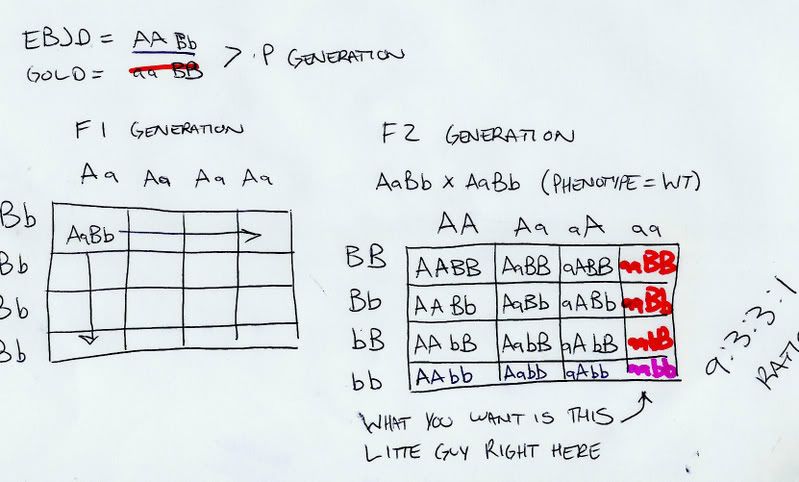
I honestly couldn't tell you what would come of an EBJD X Gold. I'm assuming the fry would be fertile, but I'm pretty certain the two color variants are not due to the same allele so you could probably have both gold and EBJD expressed at the same time. The Golds still contain the gold and blue pigment that the WT have, and that the EBJD's have in excess, so in theory you should be able to get an EBJD with the pink background.
If that's correct the first generation of Gold X EBJD would look like the WT, as all the offspring would be heterozygous, as Gold would be aaBB (homozygous recessive for Gold, homozygous dominant for EBJD) and EBJD's would be AAbb (homzygous dominant for EBJD, homozgyous recessive for gold).
So the F1 offspring from the P generation would be 100% AaBb using the classic Punnet Square.
Cross the second generation and you'd get Mendel's classic ratio of 9:3:3:1 for genetic variablilty of two alleles, WT's (AABB (1), AaBB (2), AABb (2), and AaBb (4)), EBJD (AAbb (1), Aabb (2)), Gold (aaBB (1), AABb (2)), and the elusive gold EBJD (aabb (1)).
Of course, this is all theoretical. Until someone actually breeds them or we sequence the genome of the WT vs. EBJD vs. Gold and find the locations of the mutations it's the best I can do.