

You are using an out of date browser. It may not display this or other websites correctly.
You should upgrade or use an alternative browser.
You should upgrade or use an alternative browser.

At y
At your service. E. Rhodochilus is a brackish moray species which will tolerate freshwater. One of my E. Rhodochilus were kept in FW for a year before I bought it. To be on the save side, I keep it in a BW tank with fluctuating salinity between 1.004 to 1.008 sg. To achieve this, I did not use any kind of artificial salt, instead, I directly mix seawater of 1.020 sg with my natural well water (do not use tapwater!) until I reach 1.008 sg, then I fluctuate the salinity during weekly water changes. Wish you luck and let me know if you have any questions.
At your service. E. Rhodochilus is a brackish moray species which will tolerate freshwater. One of my E. Rhodochilus were kept in FW for a year before I bought it. To be on the save side, I keep it in a BW tank with fluctuating salinity between 1.004 to 1.008 sg. To achieve this, I did not use any kind of artificial salt, instead, I directly mix seawater of 1.020 sg with my natural well water (do not use tapwater!) until I reach 1.008 sg, then I fluctuate the salinity during weekly water changes. Wish you luck and let me know if you have any questions.


wow, they look great. g. Tile is more common in the stores around me so I prefer to buy that one.All three of my E. Rhodochiluses are most happy when the water salinity is 1.006 sg. They became active, outgoing and eat like pigs!
Can u tell me the price u bought the pink lips for?
I will use the waterdrip methode to move it into my tank. Do u have any problems with brackish water? And how many morays would u recommend in a 300liter tank?
Also do you know any cool fish that can be kept with them? Sry for so many questions

wow, they look great. g. Tile is more common in the stores around me so I prefer to buy that one.
Can u tell me the price u bought the pink lips for?
I will use the waterdrip methode to move it into my tank. Do u have any problems with brackish water? And how many morays would u recommend in a 300liter tank?
Also do you know any cool fish that can be kept with them? Sry for so many questions
I live in Indonesia, that's the country where all freshwater/brackish morays came from, including the E. Rhodochilus, G. Polyuranodon, G. Tile, and even odd monsters like Strophidon Sathete and G. Meleagris, as well as cute little Uropterygius Micropterus can be found in our rivers. So you can imagine that prices of such eels are very low here when compared to other countries.
I bought all of my E. Rhodochiluses for under 7 USD each. The Uropterygius is even lower in price. G. Tile, I never bought any but it's about the same price point, maybe higher by one or two dollars. We are talking about younger speciments that are about 30 to 40 centimeters in length. Larger speciments certainly cost more.
The G. Polyuranodon however is on a league of its own, they are 2 to 3 times more expensive than other FW/BW morays, because they are the most beautiful & most sought after by collectors. Large speciments over 1 meters long could cost 70-80 USD.
More about G. Tile. Most people will tell you that these will die in FW and will require 100% seawater as the grow older. This might be true. On the other hand, everybody around here (in this country) that I know of, keep G. Tile in FW to pure brackish (max 1.010 sg). They doesn't keep G. Tiles in seawater. So, brackish is the safest bet.
Anyway, these two gentlemen seems to have been successful in keeping G. Tile in _freshwater_:
http://www.aquaticcommunity.com/predatory/freshwatermoray.php
http://www.aquahobby.com/gallery/others/e_Gymnothorax_tile.php
But even though it is possible and they have been successful, I still does not recommend to keep G. Tile on FW. Always better to put them in brackish (at least 1.006-1.008 sg). However, I can say with some confidence that you don't really need to put G. Tile on SW.
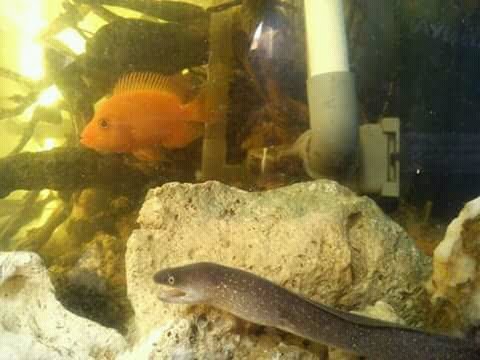
This is a G. Tile that is being kept in FW here in Indonesia for quite awhile, with no ill-effect, until it was sold. As you can see, it gets along with a large cichlid, but I personally won't recommend. If you keep G. Tile in brackish, I think you need a bracksh-tolerant fish that is bigger than the eel but who won't see the eel as food. Also, G. Tile is rather fierce when it gets bigger, so if you plan to keep several G. Tiles, I recommend to put them in the aquarium at the same time (so they have time to adapt with each other), and that they must be around the same size.
thank u for the information.. wow can't believe how cheap they are. The ones here are sometimes around 170 euro's. I will keep it in heavy brackish. Its recommended for the fish and I want them to live long and happy. Do u have any idea what to put with them In a tank?I live in Indonesia, that's the country where all freshwater/brackish morays came from, including the E. Rhodochilus, G. Polyuranodon, G. Tile, and even odd monsters like Strophidon Sathete and G. Meleagris, as well as cute little Uropterygius Micropterus can be found in our rivers. So you can imagine that prices of such eels are very low here when compared to other countries.
I bought all of my E. Rhodochiluses for under 7 USD each. The Uropterygius is even lower in price. G. Tile, I never bought any but it's about the same price point, maybe higher by one or two dollars. We are talking about younger speciments that are about 30 to 40 centimeters in length. Larger speciments certainly cost more.
The G. Polyuranodon however is on a league of its own, they are 2 to 3 times more expensive than other FW/BW morays, because they are the most beautiful & most sought after by collectors. Large speciments over 1 meters long could cost 70-80 USD.
More about G. Tile. Most people will tell you that these will die in FW and will require 100% seawater as the grow older. This might be true. On the other hand, everybody around here (in this country) that I know of, keep G. Tile in FW to pure brackish (max 1.010 sg). They doesn't keep G. Tiles in seawater. So, brackish is the safest bet.
Anyway, these two gentlemen seems to have been successful in keeping G. Tile in _freshwater_:
http://www.aquaticcommunity.com/predatory/freshwatermoray.php
http://www.aquahobby.com/gallery/others/e_Gymnothorax_tile.php
But even though it is possible and they have been successful, I still does not recommend to keep G. Tile on FW. Always better to put them in brackish (at least 1.006-1.008 sg). However, I can say with some confidence that you don't really need to put G. Tile on SW.
This is a G. Tile that is being kept in FW here in Indonesia for quite awhile, with no ill-effect, until it was sold. As you can see, it gets along with a large cichlid, but I personally won't recommend. If you keep G. Tile in brackish, I think you need a bracksh-tolerant fish that is bigger than the eel but who won't see the eel as food. Also, G. Tile is rather fierce when it gets bigger, so if you plan to keep several G. Tiles, I recommend to put them in the aquarium at the same time (so they have time to adapt with each other), and that they must be around the same size.
View attachment 1307742
And I read some sites but almost every site says something different about the length. Some say 90cm other 60cm other 40cm other 1,2m max. What is the max length they reach by you in the aquarium?
thank u for the information.. wow can't believe how cheap they are. The ones here are sometimes around 170 euro's. I will keep it in heavy brackish. Its recommended for the fish and I want them to live long and happy. Do u have any idea what to put with them In a tank?
And I read some sites but almost every site says something different about the length. Some say 90cm other 60cm other 40cm other 1,2m max. What is the max length they reach by you in the aquarium?
G. Polyuranodon could reach around 1.5 meters, while G. Tile max around 60 or 70 cm. E. Rhodochilus max at 40-50 cm.
If I am asked to make an aquarium for G. Tile, I'll make sure that it has plenty of hiding places, strong filtration and aerator. Make sure the filters are cycled first in 1.005 sg salinity & ensure tropical temperature (if you have a good heater for keeping water temperature, use it). Try to fluctuate between 1.005 (half brackish) and 1.010 (pure brackish), this is to simulate their actual environment (the rivermouth of S.E. Asia, where freshwater and saltwater collide).
During the first few weeks, they might still require live food such as river shrimps or guppies. It will take a while, but they will eventually be able to be converted into eating frozen seafood.
It is said that medium-sized brackish water fishes will do well with G. Tile, but there are three problems. First, if the fish are too big, it will see the eel as food. Second, If it's too small, the G. Tile, being a piscivore, will attempt to eat the fish. Third problem is the fact that swift fishes will eat all the available food quickly before the eel even smelled them.
I know some people who keep brackish water pufferfish (tetraodon nigroviridis) together with G. Tile, and they did well, but I won't recommend, as both species are unpredictable.
Let me ask around amongst local moray keepers here for info of what kind of fish they keep with their brackish morays and get back to you.
). Try to fluctuate between 1.005 (half brackish) and 1.010 (pure brackish), this is to simulate their actual environment (the rivermouth of S.E. Asia, where freshwater and saltwater collide).
I read that they need between 1,015 and 1,020
It would be a great help if u can ask them what they keep with them.
I searched quite a lot on fish to keep with them. Most of them kept molleys/argus/mono's or tetraodons .But my tank is to small for mono's and argus. And tetraodon is not really a good recommendation as u also said before.
I read that they need between 1,015 and 1,020
It would be a great help if u can ask them what they keep with them.
But my tank is to small for mono's and argus. And tetraodon is not really a good recommendation as u also said before.
1.020sg is already full-strength seawater, if you go for this salinity, then your filters will not be brackish anymore but will adapt to seawater-strength. I guess is that people who wrote 1.015 to 1.020 sg are assuming that you want to eventually keep the eel in seawater. Pure brackish is 1.010sg, so if you want high brackish then the range should be between 1.010 to 1.015 sg.
I will get back to you when I have more info about compatible fishes.
Actually, A friend just told me that dragon gobies could be kept successfully with various types of brackish and marine morays. However, as you might have guessed, the dragon goby is a brackish fish that is rare, and probably rather expensive. Plus it also has certain requirements of its own, so I can't say it's recommended.
I also heard that ropefishes (erpetoichtyes, a relative to bichirs) could tolerate low-end brackish water & won't bother your eels nor hogged all their food, but since you want to keep your eels in high-end brackish, maybe it's not so good idea to get a ropefish.
I'll search around to find another possibilities, so don't lose hope yet

1.020sg is already full-strength seawater, if you go for this salinity, then your filters will not be brackish anymore but will adapt to seawater-strength. I guess is that people who wrote 1.015 to 1.020 sg are assuming that you want to eventually keep the eel in seawater. Pure brackish is 1.010sg, so if you want high brackish then the range should be between 1.010 to 1.015 sg.
I will get back to you when I have more info about compatible fishes.
Actually, A friend just told me that dragon gobies could be kept successfully with various types of brackish and marine morays. However, as you might have guessed, the dragon goby is a brackish fish that is rare, and probably rather expensive. Plus it also has certain requirements of its own, so I can't say it's recommended.
I also heard that ropefishes (erpetoichtyes, a relative to bichirs) could tolerate low-end brackish water & won't bother your eels nor hogged all their food, but since you want to keep your eels in high-end brackish, maybe it's not so good idea to get a ropefish.
I'll search around to find another possibilities, so don't lose hope yet
ropefish can tolerate very low end brackish but it isn't recommended, however dragon gobies are extremely cheap here in the US and so common Walmart usually carries them. I've had 3 dragon gobies they are brackish but mine were kept in freshwater, they require sand and small food such as brine shrimp. They do get up to 24". They like hiding spots and either need to be the only of their kind or in groups of 3 or more. They are peaceful but slow to get food so no fast eaters
